

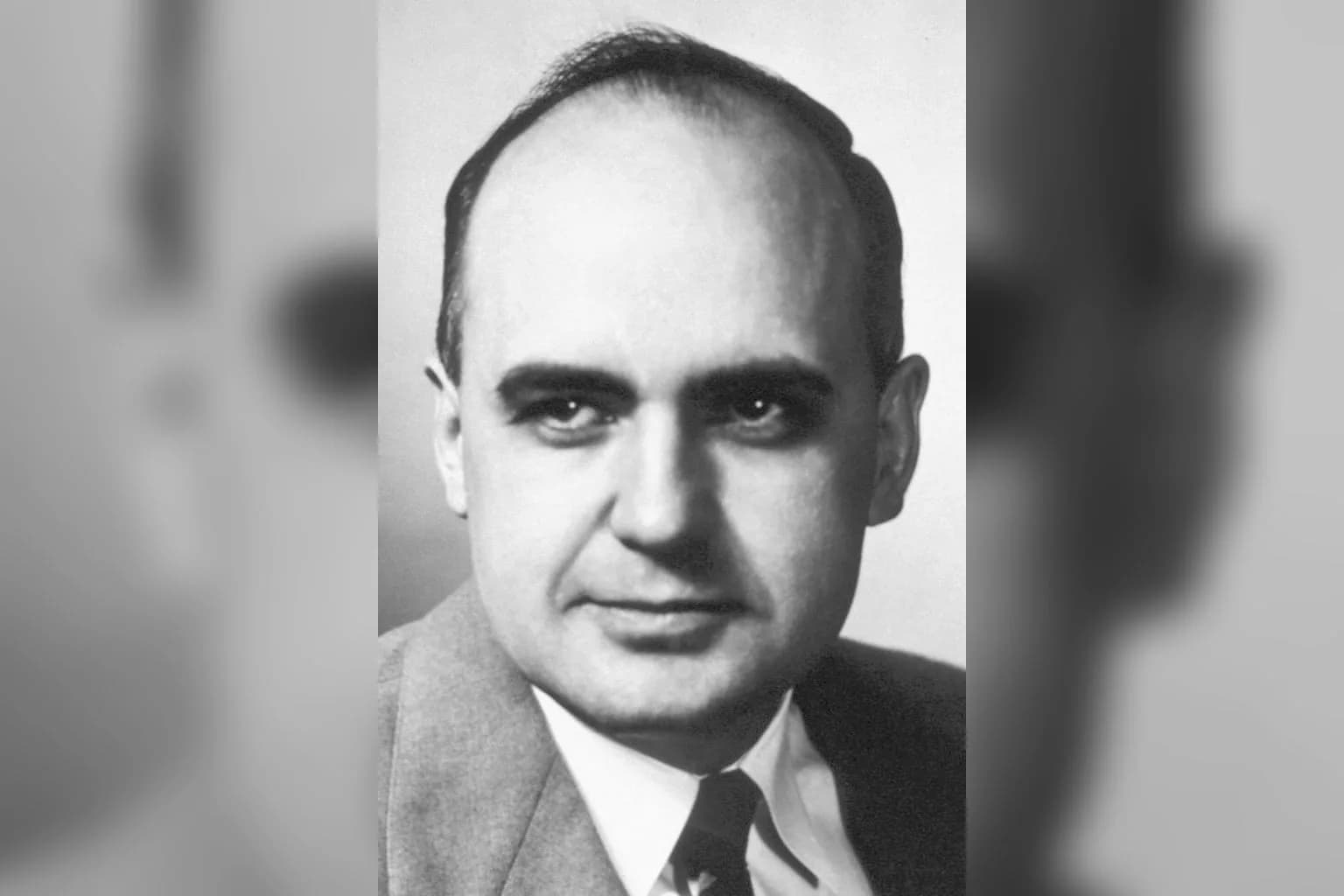
The Vials Before Dawn
In March 1963, five-year-old Jeryl Lynn Hilleman woke her father with a sore throat. Maurice Hilleman felt beneath her ear and found the parotid swelling typical of mumps. He drove to his laboratory for vials, took saliva from her parotid gland, and froze the samples. The samples preserved the virus that had made his daughter ill.
Hilleman already knew how quickly a virus could become a public problem. He had spent years studying influenza, and he had learned how much work stood between recognizing a threat and delivering protection. Jeryl Lynn’s illness placed that whole sequence in his home: a child with swollen glands, a father who recognized the disease, and vials headed for a laboratory.
He would weaken the virus and turn it into a vaccine strain bearing his daughter’s name. The work belonged to a career that produced more than 40 vaccines against serious human and animal diseases. His work is generally believed to have saved hundreds of millions of lives around the world.
How did Maurice Hilleman turn a child’s mumps sample into protection for millions?
Where Things Got Done
Hilleman grew up on his uncle’s farm near Miles City, Montana, after his mother and twin sister died during his birth. He later called the farm a place “where things got done.” The phrase suited a scientist who kept experiments running until they were finished and pushed research toward practical use.
His route into science almost led elsewhere. Hilleman had been planning to take a career-track job at the J. C. Penney store in Miles City when his older brother told him about scholarships at Montana State College. He graduated first in his class in 1941, with degrees in chemistry and microbiology, then earned a doctorate in microbiology from the University of Chicago in 1944. The scholarship altered the direction of his working life.
At Chicago, Hilleman discovered that the infectious agent behind chlamydia was a small bacterium that grew only inside cells. Scientists had considered it a virus. He made that finding at age 25, then left academia for E. R. Squibb & Sons, where wartime vaccine production set the scale of the work before him.
At Squibb in 1944, 30 women worked eight-hour shifts under Hilleman’s supervision, processing two mice per minute and harvesting about 30,000 mouse brains each day. The brains supplied material for a Japanese encephalitis vaccine intended to protect American troops in the Pacific. The operation ran at a pace of two mice a minute.
Japanese encephalitis, carried by mosquitoes, can cause seizures, paralysis, coma, and death in one out of three victims, while another third can sustain permanent brain damage. The vaccine came in three doses, and producing enough for 600,000 American troops took about three months. Hilleman’s first professional vaccine work required a production system measured in animals, shifts, and months.
The scale at Squibb gave him a working rule that would follow him for decades. A promising result had value when it could move through a dependable process and reach people before disease reached them. Influenza gave him the chance to test that rule against a worldwide emergency.
The Roosters
Hilleman spent 1948 through 1957 at the Army Medical School, later renamed the Walter Reed Army Institute of Research, studying influenza virus. He defined the small yearly viral changes called antigenic drift and the larger changes called antigenic shift. The major shifts account for the roughly three influenza pandemics that occur every century.
On April 17, 1957, Hilleman read a New York Times article about influenza among infants in Hong Kong. The epidemic had affected about 10 percent of Hong Kong’s population. He recognized a major shift in the virus and correctly predicted that the outbreak presaged a worldwide pandemic. He was the first to detect the shift that caused the 1957 Asian influenza pandemic.
He isolated the virus and tested it against blood from hundreds of servicepeople and civilians. Those samples contained no antibodies to it. When he tested more widely, immunity appeared among elderly survivors of the 1889 pandemic. The population faced a virus for which almost everyone lacked immunity.
The U.S. Public Health Service and the military-based Influenza Commission dismissed Hilleman’s warnings and called him crazy. He responded by contacting six vaccine manufacturers directly, bypassing the principal American vaccine regulatory agency. His instruction was blunt: “don’t kill the roosters.”
Fertilized eggs were essential because manufacturers incubated the virus in them to make vaccine. Hilleman needed millions of eggs, which meant breeders had to keep roosters available to fertilize them. The instruction carried his old Squibb lesson into a new setting: production had to begin while the danger was still far away.
Asian flu arrived in the United States during the first week of September 1957, as Hilleman had predicted, and vaccinations had already begun. By late fall, 40 million doses had been distributed. The pandemic still killed as many as two million people worldwide, including about 70,000 people in the United States.
Some estimates held that a million Americans would have died without Hilleman’s vaccination campaign. Vannevar Bush, Merck’s chairman and a former director of the Federal Office of Scientific Research and Development during World War II, persuaded Hilleman to direct Merck’s virus research program that year. Hilleman became chief of the company’s virus and cell biology unit.
The Flock From California
Merck gave Hilleman a place to pursue the same problem over a longer stretch of time: how to make vaccines that worked reliably for children. Measles made the source of vaccine material a central concern. John Enders of Boston Children’s Hospital had developed a measles vaccine, and Hilleman found its sample loaded with chicken leukemia virus. The virus came from the chick embryos used in vaccine production.
About 20 percent of American chicken stock carried the cancer-causing avian leukosis virus, or ALV, during the early 1960s. Hilleman used a test developed that year to detect it, and the test supplied a way to breed ALV-free chicks. His search led to Kimber Farms in California, whose flock included about 300 chickens free of ALV.
Kimber’s director of poultry research learned that Hilleman came from Montana and sold him the entire flock. A shared Montana connection secured the birds. The purchase gave Hilleman a clean source of eggs for measles work, extending the logic behind his warning about roosters into the safety of the birds themselves.
The flock outlasted the immediate project. Merck still produces vaccines using eggs from the descendants of Kimber Farms’ flock. Hilleman now had a supply of clean chick embryos and a measles strain that needed further work before it could serve children well.
More Attenuated Enders
Rubeovax, a measles vaccine based on the Enders strain, was licensed to the U.S. government in 1963. Many children who received it developed rashes and high fevers, and the fevers sometimes caused seizures. Hilleman described the vaccine as “toxic as hell.”
He first administered gamma globulin alongside the vaccine to ease some symptoms. Gamma globulin was a fraction of blood from measles survivors that contained antibodies. The measure helped address the immediate reactions, while Hilleman worked on the virus itself with embryos from the clean flock.
He passed the Enders strain through clean chick embryos an extra 40 times. The repeated passages produced a weaker virus called Moraten, for “more attenuated Enders.” The name stated the aim plainly: a virus weakened enough for vaccination.
Moraten was licensed as Attenuvax in 1968, and it has been the only measles vaccine used in the United States since then. The route to that result ran through a contaminated sample, a flock of 300 chickens, and 40 more passages through clean embryos. Hilleman kept working on a vaccine until its production material and its effect in children could support its use.
He had begun another vaccine effort from the vials he carried away after Jeryl Lynn woke him with a sore throat. The mumps virus in those frozen samples offered him a starting point with an unusually personal name.
The Name on the Strain
Hilleman isolated the virus from Jeryl Lynn’s saliva, weakened it, and produced a mumps vaccine within four years. The weakened strain carried his daughter’s name. The Jeryl Lynn strain was licensed as a mumps vaccine in 1967.
His younger daughter, Kirsten, became the first one-year-old to receive the mumps vaccine. A photograph from 1966 shows Kirsten and Jeryl Lynn receiving an experimental vaccine together. The sisters appeared together in the testing process that grew from Jeryl Lynn’s illness.
Hilleman also created a rubella vaccine in 1969. He combined it with his measles and mumps vaccines, and the MMR shot was licensed in 1971. The single injection brought together the Jeryl Lynn mumps strain, the Moraten measles strain, and rubella protection.
His work later included vaccines for hepatitis B and Marek’s disease, a lymphoma cancer of chickens caused by a herpes virus. The Marek’s disease vaccine became the first licensed vaccine against any viral cancer. President Ronald Reagan awarded Hilleman the National Medal of Science in 1988.
Hilleman retired from Merck at age 65 in 1984, then directed the Merck Institute for Vaccinology until the final year of his life. He died in April 2005. He left behind more than 40 vaccines against human and animal diseases.
The answer began in the vials from Jeryl Lynn’s swollen parotid gland. Hilleman knew how to carry a virus from a sample through weakening, testing, production, and vaccination, because he had practiced every link of that work for years. The strain in the MMR vaccine still carries the name of the five-year-old who woke him with a sore throat.



Comments (0)