

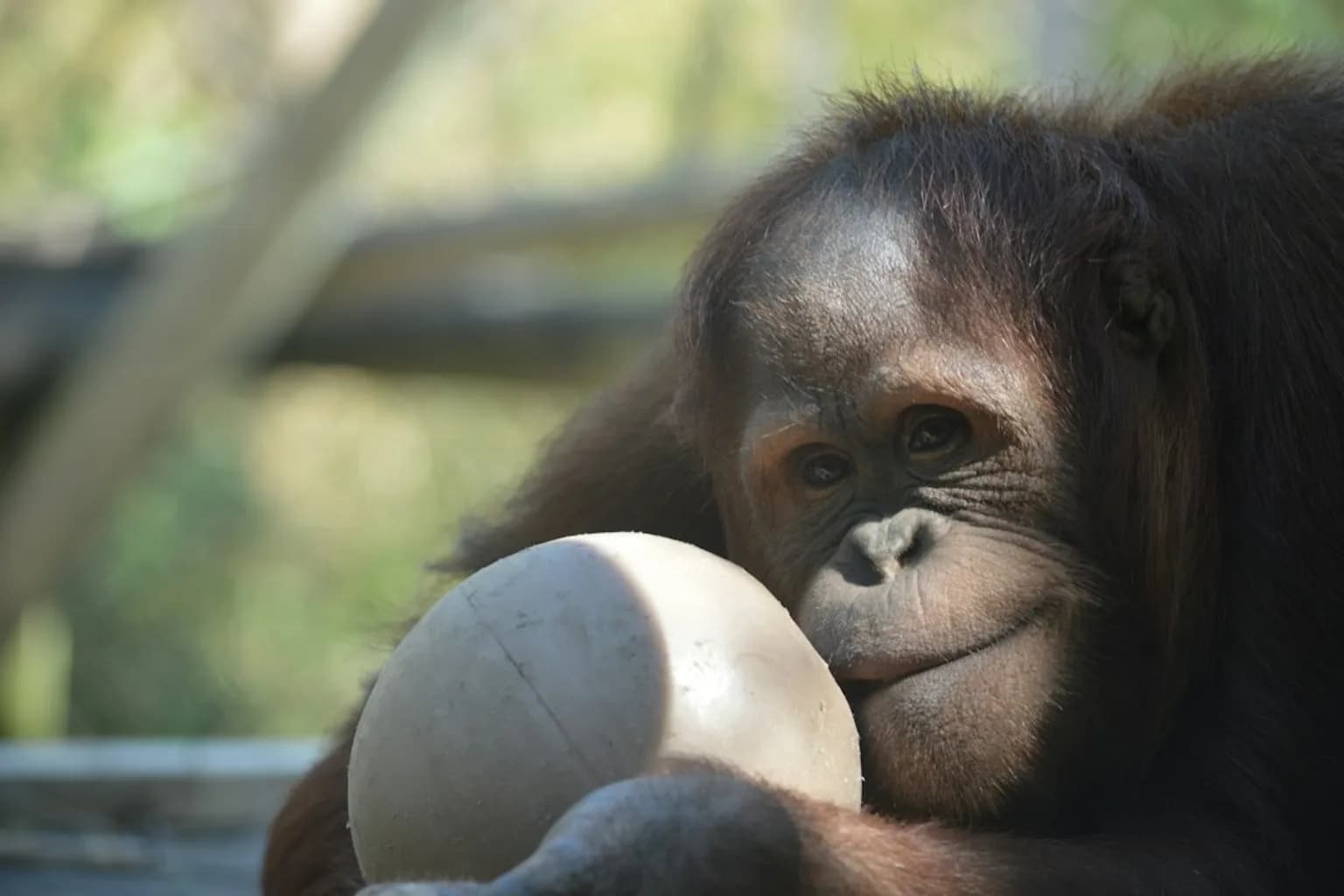
Local residents saw five baby orangutans clinging to trees in a casuarina forest on a plantation in the Bhograi area of Baleshwar district, Odisha, near the West Bengal border. About 1,000 villagers found the infants and alerted forest officials, leading to their rescue on September 8.
The three males and two females were aged 6 to 8 months. They had been abandoned in early September, more than 2,700 kilometers (1,700 miles) from the rainforests of Borneo and Sumatra, where orangutans occur naturally.
That distance has left investigators with a basic unanswered question: how did five young apes reach an Indian plantation? The Odisha Police Special Task Force and the Wildlife Crime Control Bureau opened a joint inquiry into suspected international wildlife trafficking.
The orangutans were taken nearly 400 kilometers to Nandankanan Zoological Park in Bhubaneswar on the day they were found. Zoo staff placed them in a temperature-controlled quarantine enclosure.
Pradeep Mirase, the zoo’s deputy director, oversaw their care. The older babies climbed and swung in their enclosure, while the younger ones clung to each other. Keepers gave them orangutan plush toys, and reportedly played classical music to soothe them.
Three had anemia and one had a fever when they arrived. The group was initially underweight, though staff later reported better appetites, behaviour and activity levels, alongside normal weight gain.
Orangutans normally rely on their mothers for as long as nine years. These infants had been separated from theirs at 6 to 8 months old, leaving their survival dependent on human care.
Sinan Serhadli, a wildlife trafficking expert at the Orangutan Information Centre in Indonesia’s North Sumatra province, said: “India has become the number one destination for the live trade of primates.”
India imported 41 orangutans between 2021 and 2024, according to the Convention on International Trade in Endangered Species of Wild Fauna and Flora, known as CITES.
Uttara Mendiratta, a wildlife trafficking researcher in India, said: “The profit margins are so high that they can afford to lose a few (animals) and still make a profit.” The global illegal wildlife trade is estimated at $34 billion annually, according to a 2026 study by National University of Singapore researchers.
Lionel Hachemin, global director of the Wildlife Crime Program at the International Fund for Animal Welfare, said obtaining five orangutan infants of the same age would be extraordinarily difficult even for the world’s best-resourced breeding facilities. He said moving them from their source to India could have taken one to three weeks.
Binur D. Naibaho, director of Sustainable Landscape at the Orangutan Information Centre, said some villagers in Sumatra are paid up to 15 million Indonesian rupiah ($846) to poach a baby orangutan. About 119,500 orangutans remain in the wild, according to the World Wildlife Fund.
India’s legal framework has changed in recent years. A 2020 measure allowed people to register exotic animals without proving where they came from. The country tightened its wildlife laws in 2022, giving authorities clearer powers to seize illegally traded exotic animals and prosecute traffickers.
Cases involving primates have continued. Two juvenile Sumatran orangutans were found in boxes at a checkpoint between the northeastern Indian states of Assam and Mizoram in 2022. Another orangutan was rescued in Mizoram in 2023, and a young orangutan was found in an apartment near Mumbai in November 2024. At least 23 gibbons were seized at Indian airports in 2025, according to an analysis by the nonprofit Wildlife Trust of India. Egyptian authorities also seized three sedated baby chimpanzees intended for India in May 2026.
Attention has also focused on Vantara, a 3,500-acre wildlife facility in western India that holds more than 150,000 animals from more than 2,000 species. When one orangutan was transferred there last year, India’s federal wildlife officials and its CITES authority were not informed.
That animal was returned to Indonesia on October 19 after 19 months at Vantara. Conservationists have returned orangutans to Indonesia from Thailand, while this remains the only orangutan repatriated from India so far.
In November 2025, CITES questioned Vantara shipments that included snow leopards from Germany, a bonobo said to have been bred in Iraq and a gorilla reportedly from Haiti. India’s Supreme Court cleared Vantara of allegations of wildlife trafficking and animal mistreatment in 2025.
Vantara’s 2024-25 inventory lists a Tapanuli orangutan, described as the world’s rarest great ape. Only 716 remain in the wild in a small area of Indonesia’s Sumatra island. CITES trade data shows that animal left Indonesia in 2024 and reached India via the United Arab Emirates. In September, 27 wildlife conservation and animal welfare organisations wrote to Vantara urging it to end wild-animal imports, citing more than 60,000 animals acquired by the facility in a short period.
The five infants’ future remains unresolved. Indonesia’s Ministry of Forestry said it was taking “active steps” to bring them home, and a high-level Indonesian delegation of wildlife experts was scheduled to visit India from November 22 to 26 to discuss their repatriation.
Trishala Ashok, a Bengaluru-based wildlife activist and filmmaker, said: “These five orangutans are victims of wildlife trafficking. They didn't choose to be brought to India, and their rescue shouldn't end with them being kept in a zoo. Repatriation is complicated, yes, but that cannot become a reason to stop trying.”
The case dominated Indian headlines and primetime broadcasts for days. The investigation has yet to establish who abandoned the animals, how they entered India, or where they were meant to go.






Comments (0)