
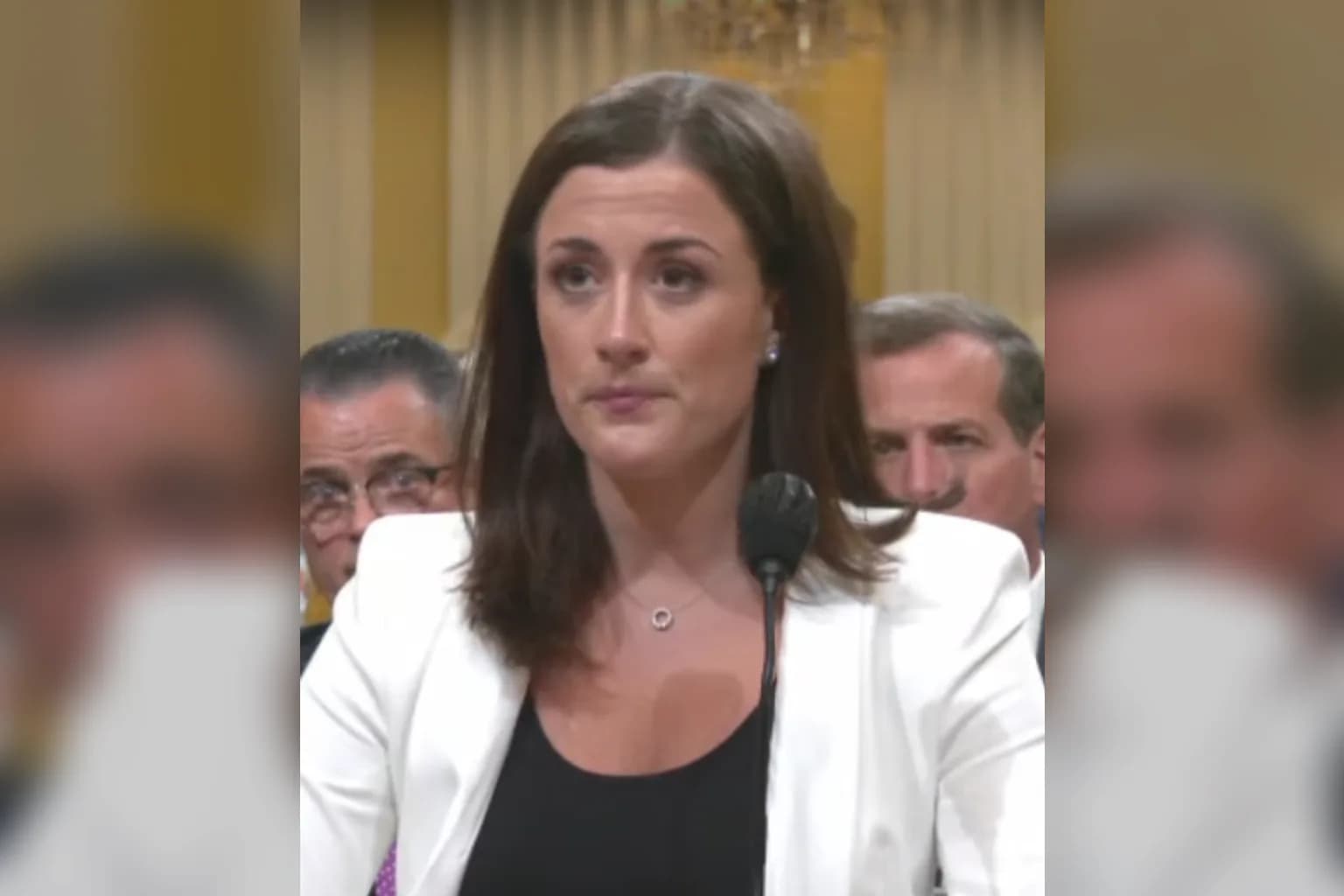
When Cassidy Hutchinson appeared before the House Select Committee investigating the 6 January 2021 attack on the US Capitol, she became a key witness against Donald Trump. Hutchinson had served as an aide to Mark Meadows, the White House chief of staff, and her June 2022 testimony was watched by over 13 million Americans.
Now a federal grand jury in Washington, DC, has rejected the Justice Department’s attempt to charge her over that testimony. Prosecutors in the department’s Civil Rights Division had sought an indictment on claims that Hutchinson made false statements.
Neville Hedley, a senior litigation counsel in the division, told Magistrate Judge Zia Faruqui in open court on Tuesday afternoon that the grand jury had rejected the proposed indictment. The result is known in legal circles as a “no true bill”.
The case concerned evidence Hutchinson gave about Trump’s conduct on January 6. She testified that Trump encouraged supporters to march to the Capitol despite knowing they were armed, and that he sought to have metal detectors removed.
She also relayed an account she said had been given to her by White House aide Tony Ornato. According to Hutchinson’s testimony, Ornato said Trump lunged towards Bobby Engel, the head of his security detail, inside the presidential vehicle after being told he could not join his supporters at the Capitol.
Hutchinson testified that Trump said something like, “I'm the effing president, take me up to the Capitol now,” according to Ornato’s account that she relayed to the committee.
She made clear at the hearing that her account of what happened in the vehicle was secondhand. Secret Service officials later denied her account that Trump grabbed for the steering wheel and the throat of a bodyguard.
No other witness corroborated Hutchinson’s account of Trump in the limo, although several people interviewed said the president had been visibly angry. When special counsel Jack Smith charged Trump in 2023 with seeking to overturn the results of the 2020 election, Hutchinson was not used as a witness.
Hutchinson has maintained that her congressional testimony was truthful. Trump has called her a “scam artist” who lied under oath.
The Justice Department investigation began after Jim Jordan of Ohio and Barry Loudermilk of Georgia, Republican allies of Trump in Congress, referred Hutchinson for possible prosecution this year. The matter was assigned to the Civil Rights Division, led by Harmeet Dhillon, a Trump loyalist.
A grand jury heard the government’s evidence in early October before declining to concur on the indictment. Some Justice Department prosecutors had concluded that winning a conviction against Hutchinson would be difficult.
Such refusals are exceedingly rare. Prosecutors need only persuade a majority of grand jurors that there is probable cause to believe a crime was committed, and grand juries generally indict when presented with evidence of alleged crimes.
Federal prosecutors in Washington have nevertheless failed several times to obtain indictments they sought since Trump returned to office in January 2025.
The decision ends this attempt to charge Hutchinson. It does not prevent the Justice Department from seeking an indictment against her again in the future.





Comments (0)