

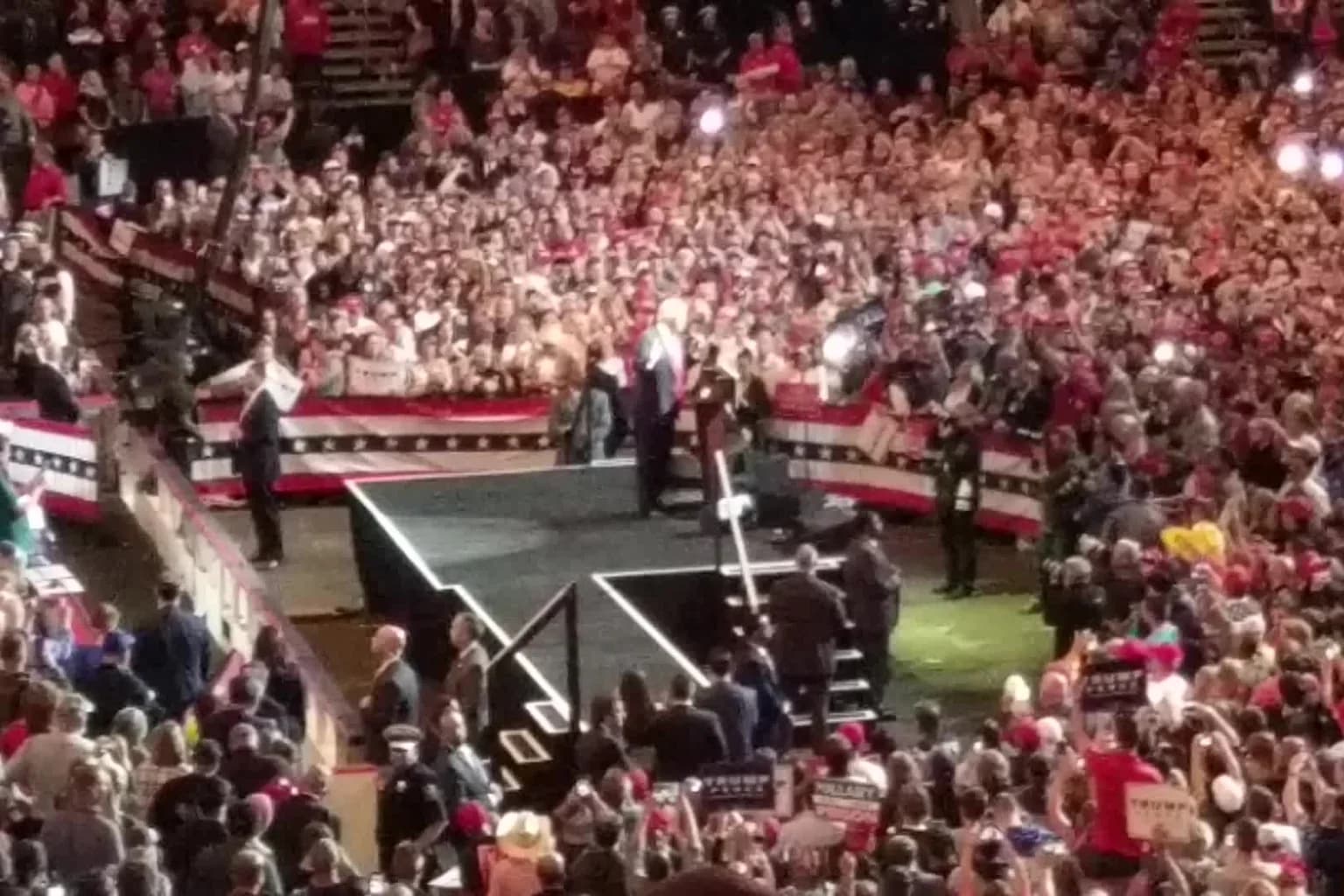
President Donald Trump used a Monday night rally for Senator Roger Marshall in Park City, Kansas, to announce an $8 billion Harvest Fuel Relief Program for farmers facing high diesel costs. The rally, at Heartland Credit Union Arena on Oct. 19, 2026, was part of Marshall’s reelection campaign.
The announcement arrived two weeks before Election Day, after White House officials had moved to address anger in farm states where Republican candidates face tight races.
Trump credited Marshall with securing the programme. “Roger Marshall is the leader who fought for that to happen. Roger got it to happen,” he said.
Diesel prices in the region had peaked at $6.53 per gallon on Sept. 22 and stood at $6.32 per gallon on the date of the rally. They had risen 75% over the past year from $3.63 per gallon.
Farmers have also faced higher fertiliser prices amid the Iran war and disruptions to shipments through the Strait of Hormuz. The US-Iran conflict has restricted fuel shipments passing through the strait.
Trump’s decision to import more foreign beef, his tariff regime and the high fuel costs during the Iran war have also angered farmers and ranchers.
The pressure has landed as farm debt reached a record high of more than $600 billion and monthly Chapter 12 bankruptcies climbed to a six-year high in April.
A September survey by Purdue University’s Ag Economy Barometer found that 48 percent of respondents thought the United States was headed in the “right direction”, down from 74 percent in July 2025. More than half named higher input costs as a leading concern, while 35 percent expected their operations to be worse off financially one year from now, compared with 22 percent who held more positive expectations.
The Farm Service Agency will administer the aid as one-time payments. It will use a uniform formula, with commodity-specific rates due from the Department of Agriculture, or USDA, in November. Farmers will not need crop insurance coverage to take part, though they will have to wait several more weeks to learn the amounts they can expect.
The payments could still face a fight in Congress.
Earlier this year, the USDA’s Farmer Bridge Assistance program made $12 billion in one-time payments to more than 560,000 farmers. Government payments currently make up some 30 percent of net farm income, according to Joe Glauber, a former chief economist at the USDA. Government funding for agriculture was expected to reach about $55 billion in 2026 alone, including an $11 billion request still awaiting congressional approval.
Brooke Rollins, the agriculture secretary, said: “This $8 billion dollar investment will help bring certainty to our farmers during this harvest so they can continue to feed our nation.” She called Trump “the most pro-farmer president of my lifetime.”
Zippy Duvall, president of the American Farm Bureau Federation, said: “We appreciate President Trump and [Agriculture] Secretary [Brooke] Rollins recognizing that higher diesel prices have squeezed farmers' bottom lines.”
Gary Wertish, president of the Minnesota Farmers Union, took a different view. “It's like an arsonist putting out a fire that he caused,” he said. “It's not going to have much of an impact.”
Glauber said the programme did not deal with the source of fuel costs. “Unless the underlying problem is resolved, farmers are going to continue to face high costs for diesel. This is a temporary thing that is very transparent, and it's aimed to get voters to vote Republican in November.”
Trump tied the prospect of further aid to the election result. “When the Republicans win, we will pass even more funding for our farmers. We love our farmers,” he said.



Comments (0)