

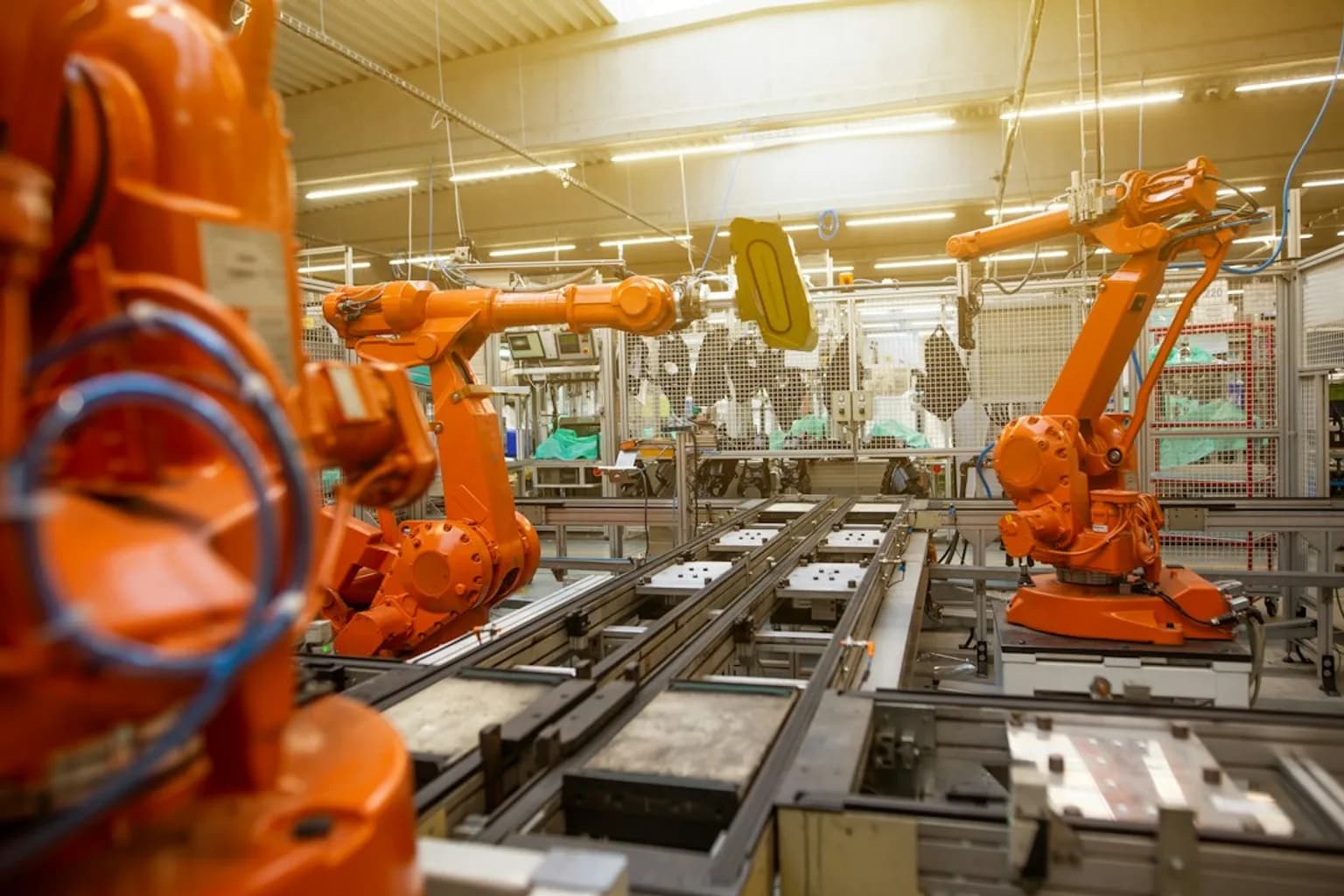
President Donald Trump’s proclamation on imported factory robots is best read as a strategic warning to a supply chain the United States still needs: it treats foreign-made systems as a national security threat, yet stops short of immediately taxing the imports on which major American manufacturers depend.
Trump has directed the Commerce Secretary and the U.S. Trade Representative to begin negotiations with trading partners and report back within 180 days. The directive calls for agreements adjusting imports of robotics, industrial machinery and their components.
If those agreements are absent at the end of that period, the proclamation says the president may impose tariffs, duties, quotas and fees on robot imports.
The administration’s case rests partly on a Department of Commerce investigation led under Secretary Howard Lutnick. The investigation found that robot imports pose risks to the US industrial base and could undermine long-term competitiveness in a field it considers vital to national security.
Commerce also found that imported robots may carry significant cybersecurity vulnerabilities with potentially severe consequences for the United States. The secretary of commerce said both the value of imported robotics systems and cybersecurity risks had grown over the past decade.
Trump’s proclamation describes industrial robots and machinery as essential to making US military weapon systems. Robotics also serve mission-critical military and law-enforcement work, as well as critical infrastructure sectors including agriculture, automotive and electronics manufacturing.
The difficulty for the administration is that domestic production does not yet offer a ready substitute. The proclamation acknowledges that US robotics companies do not make enough industrial robots to meet national security needs, and that the United States relies on foreign imports for most kinds of robotics, industrial machinery and components.
Major US automotive and aerospace companies buy large robotic arms from FANUC, ABB, Yaskawa and KUKA, whose headquarters are in Japan, Switzerland and Germany. No US company currently offers comparable heavy-duty hardware for large industrial robotic arms.
That leaves companies including General Motors, Ford, Tesla, Boeing and Lockheed Martin exposed to the outcome of the negotiations, since the same imported equipment supports production ranging from commercial vehicles to military weapon systems.
The scale of that dependence is reflected in recent deployment. The International Federation of Robotics reported nearly 38,500 new US installations of industrial robots in 2025.
Robotics and industrial machinery generated approximately $7.1 trillion in shipments of manufactured goods in 2024 and the production of approximately $86 billion worth of equipment in 2024.
The October 28 action follows an earlier step by Trump’s Federal Communications Commission. In July 2026, the FCC banned new models of foreign-made robots, including robotic vacuums, four-legged robot dogs and humanoid robots.
That earlier action exempted industrial robot arms and other fixed or stationary systems commonly used in automotive factories and logistics warehouses.
Investment is increasing, though the administration says it remains below US demand. FANUC, Teradyne Robotics and Yaskawa have announced investments aimed at expanding US robot manufacturing.
For now, the proclamation sets a deadline rather than a tariff rate. Its leverage lies in the prospect that the equipment central to American industrial production could face new import costs if the negotiations fail.

Comments (0)