

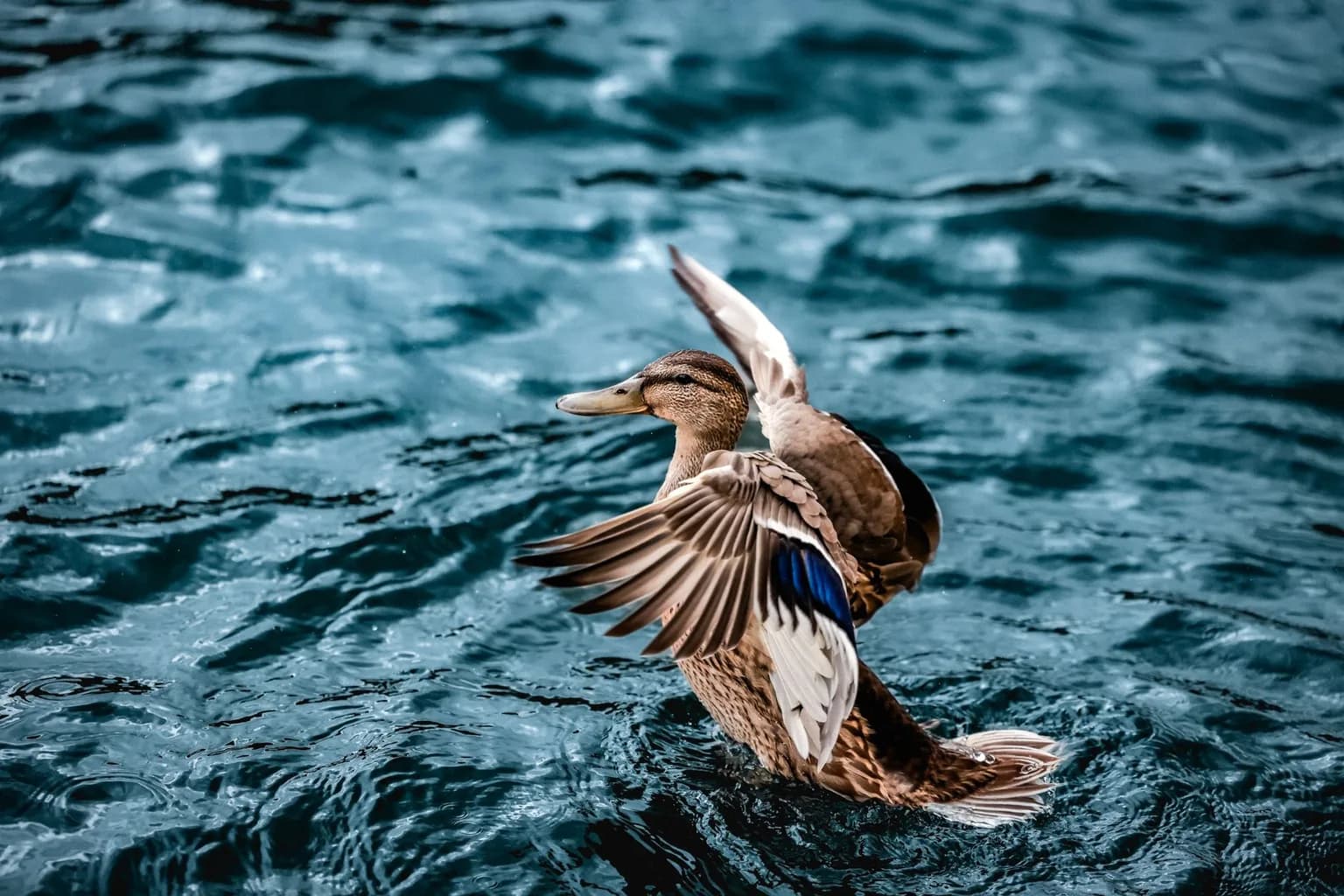
In a water tank, a small robotic vehicle swam up from depth and broke through the surface to begin flying. The machine, designed by engineers at MIT and EPFL in Lausanne, Switzerland, is called a flapping-wing aerial-aquatic vehicle, or FAAV.
Its task is difficult because water is roughly 1,000 times denser than air, demanding different mechanics from the same set of wings.
The FAAV weighs less than 300 grams (about half a pound). It has a central fuselage, two flexible wings and a steerable motorized tail. The wings are thin membranes coated with hydrophobic nanoparticles, while a waterproof electric motor drives a crankshaft that moves them up and down at preset frequencies.
The team led by Raphael Zufferey, an Assistant Professor of Mechanical Engineering at MIT who runs the institute's AURA Lab, based the robot's flapping rates on data from diving birds.
Tests of wings measuring 60, 80 and 100 centimeters across found that the 80-centimeter version worked most reliably. It was flexible enough to reduce the force of its movement in water, while remaining firm enough to keep the vehicle airborne.
At about five flaps per second, the robot swam at nearly 1 meter per second and flew at around 6 meters per second.
The team found that the vehicle could leave the water without feet, unlike birds, which use theirs during take-off. A pitch of 70 degrees let it make the transition without its wingtips touching the surface.
Experiments took place in the water tank and at Lake Geneva, Switzerland. The researchers estimate that a single charge could cover not quite four miles in the air or a little over a mile of swimming.
Zufferey said the intended users could include oceanographers, marine biologists and coastal communities. “Our dream vision is for oceanographers, marine biologists, and members of coastal communities to launch this robot from a boat, or from shore, and it would fly close to the area of interest, such as an iceberg or a port facility, or over a pod of whales.”
The researchers are working on wings that can turn as well as flap. They also plan to test the robot in turbulent conditions, including choppy water and wind.





Comments (0)