

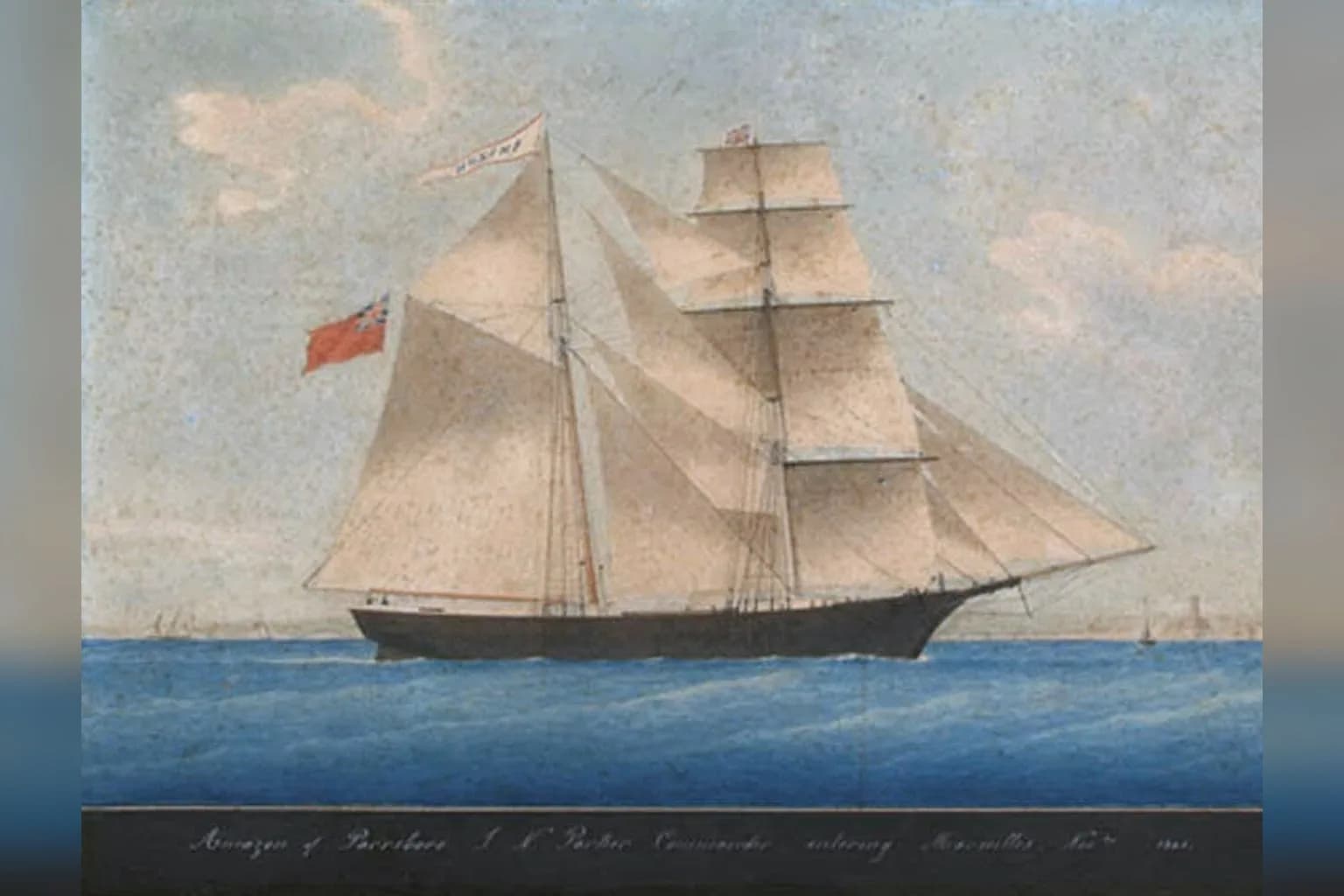
A Ship That Would Not Answer
Captain David Reed Morehouse saw the brigantine on 4 December 1872, moving erratically near the Azores. His own ship, the Dei Gratia, drew close enough for him to hail the stranger. No answer came back. Morehouse sent his first mate, Oliver Deveau, and his second mate, across in a boat. They boarded the Mary Celeste and found her completely deserted. Neither Morehouse nor Deveau was ever charged in connection with the disappearance.
Morehouse knew the name on the ship’s stern. Benjamin Briggs, the Mary Celeste’s captain, was his friend. Briggs and Morehouse were friends before the Dei Gratia encountered the drifting ship.
The ship still had sails set. Her hull could still carry her. Yet the people who had sailed from New York had vanished. Captain Benjamin Spooner Briggs had brought seven crewmen, his wife and their two-year-old daughter aboard. The Mary Celeste was generally seaworthy and under partial sail when the Dei Gratia reached her.
The absence had one immediate sign. The Mary Celeste’s only lifeboat was gone. It normally rested over the main hatch, where Deveau and his second mate found its place empty. The missing boat was the sole clue to the whereabouts of the people who had been aboard.
They found a disappearance inside a ship that could still move through the Atlantic. Why did Briggs leave a ship that could still carry them to safety?
The Things Left Behind
Deveau began with the ship in front of him. The mainsail was down and secured. Some foresails were secured as well. The rigging looked bedraggled, and the vessel moved with only part of her canvas working. Two of her three hatches stood open, with their covers lying on the deck nearby.
The rooms below gave the boarding party another set of clues. The cabin and galley were wet. The compass pedestal had been knocked over. One of the ship’s pumps had been taken apart. Three and a half feet of water stood in the ship’s bottom, while one of her two pumps lay disassembled.
The cabins held a different kind of division. The crewmen’s belongings remained in their quarters. Charts had been thrown about. The ship’s papers were gone, along with Briggs’s navigational instruments. The chronometer, sextant, navigation book and ship’s register had disappeared, while the log book stayed on a desk in the mate’s cabin.
The Voyage Goes Quiet
Briggs had left New York for Genoa on 7 November with a cargo that made the voyage commercially valuable. The Mary Celeste carried 1,701 casks of industrial alcohol in her hold. The ship was a 282-ton brigantine, large enough to carry a family, a crew and a full cargo across the Atlantic. Ten people sailed aboard when the voyage began.
The written trail ends on the morning of 25 November. The log slate placed the ship six miles northeast of Santa Maria, the easternmost island in the Azores. Its final entry gave the Mary Celeste’s position at 8 a.m. that morning. The next documented sighting came from Morehouse’s ship.
The other may have gone into the missing boat.
When Deveau came aboard, the Mary Celeste was travelling roughly westward. Genoa lay ahead through Gibraltar and the Mediterranean. Her erratic course took her away from that route. The ship was sailing in the opposite direction from the southeastward course she should have followed.
The departure took place sometime between the final log entry and the Dei Gratia’s discovery. Historians place the abandonment somewhere between 25 November and 4 December. The people in the missing boat never entered the written story again.
The Cargo That Stayed
Deveau had found a ship whose commercial load remained aboard, even though its captain, family and crew had gone.
The food and water made the empty decks harder to explain. The Mary Celeste held six months of provisions. Ten people had disappeared from a vessel that still carried enough supplies to sustain them for months. The ship had a six-month supply of food and water aboard when the Dei Gratia’s men arrived.
Hunger had not driven the party away from the ship. A ruined hull had not forced them into the lifeboat. A plundered hold had not left a clear motive behind. The missing navigational instruments fit an attempt to travel in the boat, yet the belongings left in the cabins suggest that departure came before the party could gather everything.
Deveau had a practical decision to make. He proposed sailing the deserted brigantine to Gibraltar. Morehouse gave him two seamen for the work. Deveau took command of the Mary Celeste and set out for Gibraltar with a makeshift salvage crew. The crew of the Dei Gratia could bring the ship to land, though Briggs and the other nine people never arrived with her.
A Court Looks for Violence
The Dei Gratia reached Gibraltar on 12 December. The Mary Celeste arrived the following morning. A British vice-admiralty court opened salvage proceedings, and Frederick Solly-Flood, Gibraltar’s attorney general, led the inquiry. The court convened on 17 December and continued its proceedings until 25 February.
Chief Justice Sir James Cochrane presided over the inquiry. Solly-Flood brought the force of Gibraltar’s attorney general into a salvage hearing that had become an investigation into the fate of ten people. The ship’s arrival gave the court a physical object to examine, while the missing boat kept the people at the center of the inquiry out of reach.
Solly-Flood pursued a violent explanation. He remained convinced that foul play had caused the abandonment. He believed crew members might have murdered Briggs and his family. His theory made the condition of the ship central to the court’s inquiry.
Horatio J. Sprague, the United States consul in Gibraltar, sought to protect Briggs’s reputation as the inquiry unfolded. His role placed Briggs’s standing alongside Solly-Flood’s suspicions. The court therefore had to test what the ship could show, rather than turn the vanished captain into an answer for events nobody aboard could describe.
The court examined the ship from the waterline upward. A surveyor inspected the vessel. A diver examined her underwater. Officials also inspected the alcohol cargo, which had travelled across the Atlantic without the people who had loaded and tended it. The inquiry included both a ship’s survey and an underwater examination.
John Austin carried out the survey of the vessel. Ricardo Portunato examined her underwater. Their inspections gave the court two ways to look for damage that might have made the ship impossible to keep afloat, and the Mary Celeste remained a vessel capable of being sailed into Gibraltar.
The Sword Gives Up Its Secret
A sword in Briggs’s cabin gave the inquiry one apparent lead. Marks on the blade were described as possible bloodstains. Such a finding could have connected the empty cabin to Solly-Flood’s theory of murder. The court sent the marks for chemical testing. The tests showed that the supposed bloodstains on Briggs’s sword were not blood.
The result removed the clearest physical suggestion of an attack. The sword remained in an empty cabin, though it could no longer carry the weight of a killing. The intact barrels pointed the same way. The court had a missing party and an abandoned ship, yet it had no proof that violence explained either.
Captain R. W. Shufeldt of the United States Navy later reviewed the inquiry and challenged Solly-Flood’s accusations. Shufeldt argued that the evidence supported no crime at all. His review sharpened the divide that the court’s own tests had created: the ship contained troubling signs, yet the physical evidence did not establish violence.
After more than three months, the court found no evidence of foul play. The salvagers received one-sixth of the $46,000 for which the ship and cargo had been insured. The court’s finding ended the official search for a crime without establishing what caused the abandonment.
Solly-Flood had asked whether the people aboard had harmed one another. The court left that question without support. It also left every other explanation facing the same obstacle: the people who could have described the emergency had vanished with the lifeboat.
A Blast Without Fire
The cargo suggested another danger. Dr. Oliver Cobb proposed that alcohol fumes could have escaped from the porous red-oak barrels. Those fumes, he argued, could have created a threat of explosion. Cobb’s theory held that the presence of Briggs’s wife and young daughter could have hastened a decision to remove everyone from the ship.
Cobb’s proposal began with the cargo that the court had already found intact. His theory did not depend on missing barrels or a stolen load. It depended on fumes escaping from the barrels as they travelled in the hold, creating a danger that would have been invisible until it made itself known.
The idea fits several facts without resolving the disappearance. A captain frightened by fumes could take the boat away from the ship while judging the danger from a distance. The open hatches could fit an effort to air the vessel. The missing boat and navigational instruments could fit an organized departure. None of those objects preserves the moment when the boat was lowered.
Andrea Sella, a chemist at University College London, tested the mechanism in 2006 for the History Channel. He recreated an alcohol-vapour explosion scenario. The experiment showed that alcohol fumes could create a blast wave strong enough to lift hatches without leaving scorch marks.
Sella’s experiment supplied a result that matched the kind of physical evidence the Mary Celeste lacked. A blast could move the hatches without leaving the burn marks people might expect from an explosion. The test could show how fear began aboard the ship. It could not show what happened once Briggs and the others had left her.
The experiment tested a physical possibility. It showed how a sudden blast could alarm people aboard a wooden ship while leaving little visible fire damage. The Mary Celeste supplies no surviving account of fumes, ignition or a blast. The experiment can explain a reason for fear, while the missing boat still holds the outcome beyond the ship.
The Story That Remained
Years later, Arthur Conan Doyle helped turn the disappearance into a legend. His 1884 story, “J. Habakuk Jephson’s Statement,” appeared in Cornhill Magazine as a fictional account presented as a survivor’s statement. Doyle’s version even misspelled the ship’s name as “Marie Celeste.” The invented survivor supplied a voice that the real case had never possessed.
Another supposed voice surfaced in 1913. The Abel Fosdyk papers claimed to be the diary of a lost passenger and described a deck collapse. Historians exposed the papers as a hoax. The real mystery remained smaller and harder than its later stories: a ship, a lifeboat and ten missing people.




Comments (0)