

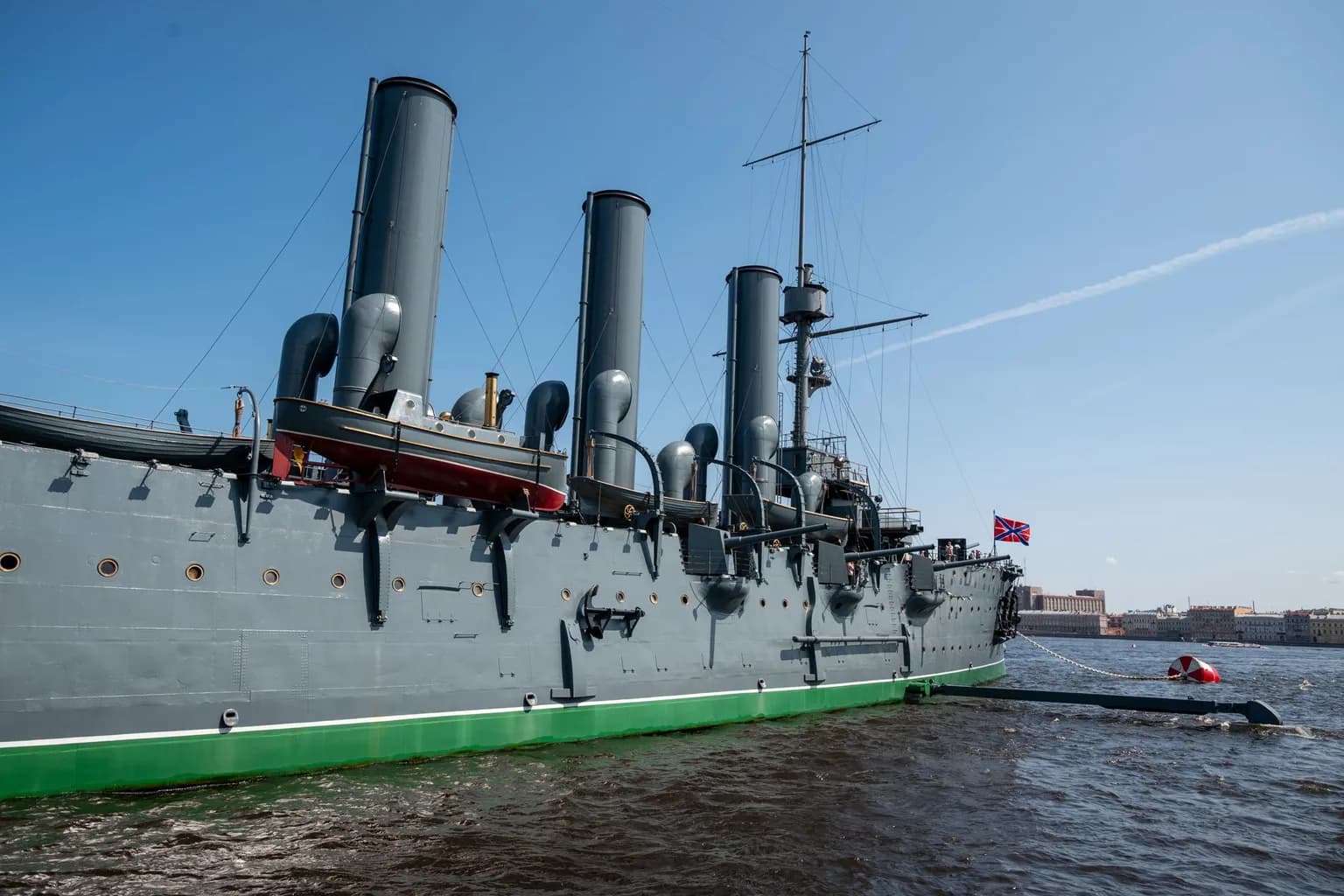
A Signal Across the Neva
On the evening of October 25, 1917, the battleship Aurora fired a blank shell across Petrograd, signalling the assault on the Winter Palace, where the Provisional Government’s ministers remained. Russia still used the Julian calendar, thirteen days behind the calendar used elsewhere, so Petrograd’s October 25 was November 7 beyond Russia’s borders. The shell was a signal for an attack, fired from a warship with an empty round rather than an explosive shot.
Lenin had spent the previous evening in hiding, pressing the Bolshevik Central Committee to move before the coming day. “The situation is critical in the extreme,” he wrote, demanding the arrest of the government and the disarming of officer cadets “this very evening, this very night.” Lenin called delay fatal, yet the Winter Palace still stood when Aurora’s gun sounded.
Outside the palace, Red Guards, soldiers and sailors had already taken much of Petrograd’s working machinery: its crossings, communications and transport. Lenin wanted the operation understood as power seized for the Soviets, the councils of workers’ and soldiers’ deputies that had grown during the year’s first revolution.
How did Lenin turn a blank shell into a revolution’s enduring image?
When the Garrison Chose the Streets
Petrograd reached Aurora’s moment through a breakdown in military obedience during the February Revolution. Food rationing announced by the tsarist government helped set the crisis moving, and marchers gathered for International Women’s Day on February 23 were joined by striking workers and socialist agitators. The demonstrations grew until they included most of Petrograd’s population by February 25. More than 200,000 workers were involved in strikes by that day.
The crowds had already formed under pressure that reached well beyond a single march. Petrograd’s flour stockpile had only ten more days left, while 90,000 workers from 58 factories were on strike. The Bolshevik Petrograd Committee called on workers to overthrow the Tsar, and a city facing a shrinking food supply became the setting for a political confrontation that soldiers would soon have to answer with their own choices. Petrograd’s flour reserve was running down as the strikes spread.
The government barricaded streets and ordered troops to fire on the demonstrators. General Khabalov’s soldiers opened fire on striking workers, killing 169 and injuring more than 1,000.
The fourth company of the Pavlovsky Regiment rushed into the street after learning that part of its own regiment had fired on workers. Bolshevik agitators visited soldiers of the Volynsky Regiment, whose men decided to kill the commander of the company that had fired on demonstrators and arm themselves. Soldiers in two Petrograd garrisons also shot their officers rather than obey orders to fire on civilians.
The Litovsky and Preobrazhensky Regiments joined the armed uprising and stormed the Main Arsenal, liberating 40,000 rifles. By nightfall, 66,000 men of the Petrograd garrison had joined the striking workers, fully armed.
Nicholas II abdicated power to his brother Mikhail, who refused it. Workers and soldiers re-formed the Petrograd Soviet as Duma delegates created a Provisional Committee of government, leaving two centres of authority in the capital. The Soviet’s Order No. 1 directed soldiers to accept orders from the Soldiers’ Soviet and their locally elected committees. The order gave the Soviet ultimate authority over the armed forces.
A Government With Divided Power
Prince Georgy Lvov became premier of the Provisional Government, which drew mainly from Constitutional Democrats and Octobrists, while Aleksandr Kerensky served as its lone Socialist and minister of justice. The new government declared a general amnesty for political prisoners and abolished discrimination based on nationality or religion. It also governed alongside the Soviet, whose authority over soldiers gave every decision a second audience.
N. S. Chkheidze, a Menshevik, became leader of the Soviet, and its first issue of Izvestia appeared as the newspaper of the Petrograd Soviet. The new body could speak to the city while Order No. 1 shaped the chain of command within its garrison. Its public voice and its authority over soldiers gave the Soviet a practical presence alongside the ministers claiming authority through the Provisional Government. Chkheidze led the Soviet as it began publishing its own newspaper.
Trotsky later called the arrangement “Dual Impotence.” Bolshevik membership had steadily reached 24,000 people before February, yet the rebuilt Soviet initially belonged largely to Menshevik leaders including N. S. Chkheidze and Tsereteli. The Bolsheviks still had to win the institution through which they hoped to govern.
Kerensky became premier after Lvov, and in June he launched an offensive against the Austro-German armies. It was completely routed by July 7. Soldiers, sailors and workers then staged an uprising in Petrograd from July 16 to 18, while Bolsheviks made an ill-prepared attempt to take power. The government easily foiled the July attempt.
Lenin fled into hiding in Finland after the failed uprising, while Trotsky and several leading Bolsheviks were arrested. The next attempt would begin inside those institutions.
Lenin Wants the Soviets
By early fall, elected Leninist majorities held the soviets of Petrograd and Moscow, and Trotsky led the Petrograd Soviet. Control of the Petrograd Soviet positioned them to reach beyond it toward the government.
Trotsky described the people gathering in Petrograd through the figure of a labourer from the village, standing idle for hours in the “tails,” or lines. He said that person was “naturally imbued with hatred” for people who were better dressed and richer, because wealthy customers could pay twice for products without cards. Trotsky gave that account at a Petrograd Soviet meeting.
The pressure outside the Soviet was severe. Gross industrial production in 1917 had fallen by more than 36 percent from its 1914 level, and more than a million workers took part in strikes during September and October. By autumn, peasant action against landowners had spread to 482 of 624 counties. The Bolsheviks carried their promise of “Peace, Land, and Bread” into a country already demanding all three.
Lenin argued that the Provisional Government had become weak enough for an armed uprising. He said that a government offering democratic peace, land to peasants and restored democratic institutions would be one “nobody would be able to overthrow.” He also warned, “History will not forgive us if we do not assume power now.” For Lenin, Petrograd offered a brief opening that demanded action.
On October 10, the Bolshevik Central Committee voted in favour of an armed uprising. Six days later, the Bolsheviks had set their plans in motion and secured full control of the Petrograd Soviet. Trotsky organized Red Guard militias and rallied troops loyal to the Bolshevik cause, while the Military Revolutionary Committee mobilized workers and soldiers.
Kerensky Raises the Bridges
Kerensky moved on the morning of October 24. His security forces occupied the offices of Rabochiy Put, the Bolshevik newspaper, and he ordered the bridges across the Neva raised to impede the insurrection.
Lenin answered from hiding in a letter to the Central Committee written that evening. “Everything now hangs on a thread,” he wrote, calling for all districts, regiments and forces to mobilize and send delegations to the Military-Revolutionary Committee and the Bolshevik Central Committee. He demanded that power remain out of “the hands of Kerenskii and Co. until the 25th.” Lenin treated the government’s move as an instruction to act at once.
The Military Revolutionary Committee answered by mobilizing workers and soldiers and stationing loyal Red Guards at strategic points across Petrograd. The committee had been created by the Petrograd Soviet, where Trotsky was chairman, giving its armed operation an institutional home. It moved against the systems that kept a capital connected: the telegraph, bridges, railway stations, State Bank and telephone exchange.
Committee forces seized each of those key installations, while Kerensky fled to the front seeking troops. The government’s action against a newspaper had opened a contest for the city’s arteries, and the committee rapidly gained them. Red Guards occupied key sites on the night of November 6, the Gregorian-calendar date for Petrograd’s October 24.
By the following evening, Bolshevik forces controlled Petrograd apart from the Winter Palace, the seat of the Provisional Government. The palace was the remaining exception in a city held by Red Guards. Its ministers still had a building, while the Bolsheviks held the crossings and the messages that might have brought them help.
The Gun and the Palace
Smolny Palace, a former educational institution, served as Bolshevik headquarters as the Military Revolutionary Committee besieged the Winter Palace. The Second All-Russian Congress of Soviets met at Smolny while the palace fell. Lenin had insisted that the Bolsheviks seize power “not in opposition to the Soviets but on their behalf,” and the Congress gave that claim a body waiting to act.
The Congress brought together a political audience for the assault underway elsewhere in Petrograd. Moderate socialists and Mensheviks walked out in protest as events moved toward their decision at the palace. Their departure left Lenin and the Bolsheviks ready to present the transfer of power as the work of the Soviets, even as Red Guards, soldiers and sailors surrounded the government’s remaining position. Moderate socialist and Menshevik factions left the Congress in protest.
On the evening of October 25, Aurora fired its blank shell, signalling the assault. The shell signalled the start of the attack on the Winter Palace; it did not blast the palace apart. That precise detail gave the event a theatrical clarity: a sound across the city, followed by the final push against the government’s last position.
By early morning on October 26, the Winter Palace was completely under Bolshevik control. Bolshevik forces arrested the ministers, ending the Provisional Government, while Kerensky evaded capture. The arrest of the ministers brought the government to an end, and the Congress announced that power would pass to the Soviets.
The Congress issued the Decree on Peace, calling for an immediate end to Russia’s role in the First World War, and the Decree on Land, redistributing aristocratic and church land to the peasantry. On October 27, the Council of People’s Commissars was officially formed with Lenin as chairman. Moderate socialists and Mensheviks walked out of the Congress in protest, while Lenin’s new council began to govern.
A Scene Built for Repetition
Twenty years after Aurora’s signal, Stalin wanted a film that showed the October Revolution and the men he presented as responsible for it. Lenin in October entered production on August 10, 1937, at the Mosfilm studio, and was ready for release on November 7, three months after shooting began and in time for the revolution’s twentieth anniversary. The film recreated Aurora’s blank shot as the signal for the Winter Palace attack.
The film showed Lenin secretly arriving at the Petrograd train station, where a worker named Vasily escorted him through a security cordon. It also staged a clandestine Bolshevik Central Committee meeting where the uprising was planned, turning decisions made amid an unstable capital into scenes with a clear route toward the palace and the Congress. Vasily appears in the film as Lenin’s bodyguard at the station.
The film also showed Lenin secretly arriving at Petrograd’s train station, a clandestine Bolshevik Central Committee meeting, and a declaration of victory at the Second All-Russian Congress of Soviets. Its Lenin tells the Congress: “Comrades! The workers’ and peasants’ revolution, the necessity of which the Bolsheviks have always spoken of, has been accomplished!” The story of an improvised struggle now had a fixed sequence of scenes, with Aurora’s report as its sharpest sound.
Stalin’s scenes were expunged when the film was reissued in 1958 during de-stalinisation. The picture itself remained in circulation, carrying the palace assault into a later political age. During China’s Cultural Revolution, Lenin in October and Lenin in 1918 were the only Soviet feature films repeatedly screened to the public.
Lenin turned the blank shell into an enduring image by placing armed action beside the Soviet Congress and calling the seizure power for the Soviets. The film made that image portable: Aurora fires, the Winter Palace falls, and Lenin speaks at the Congress. Its gun fires a blank shell across Petrograd.




Comments (0)