

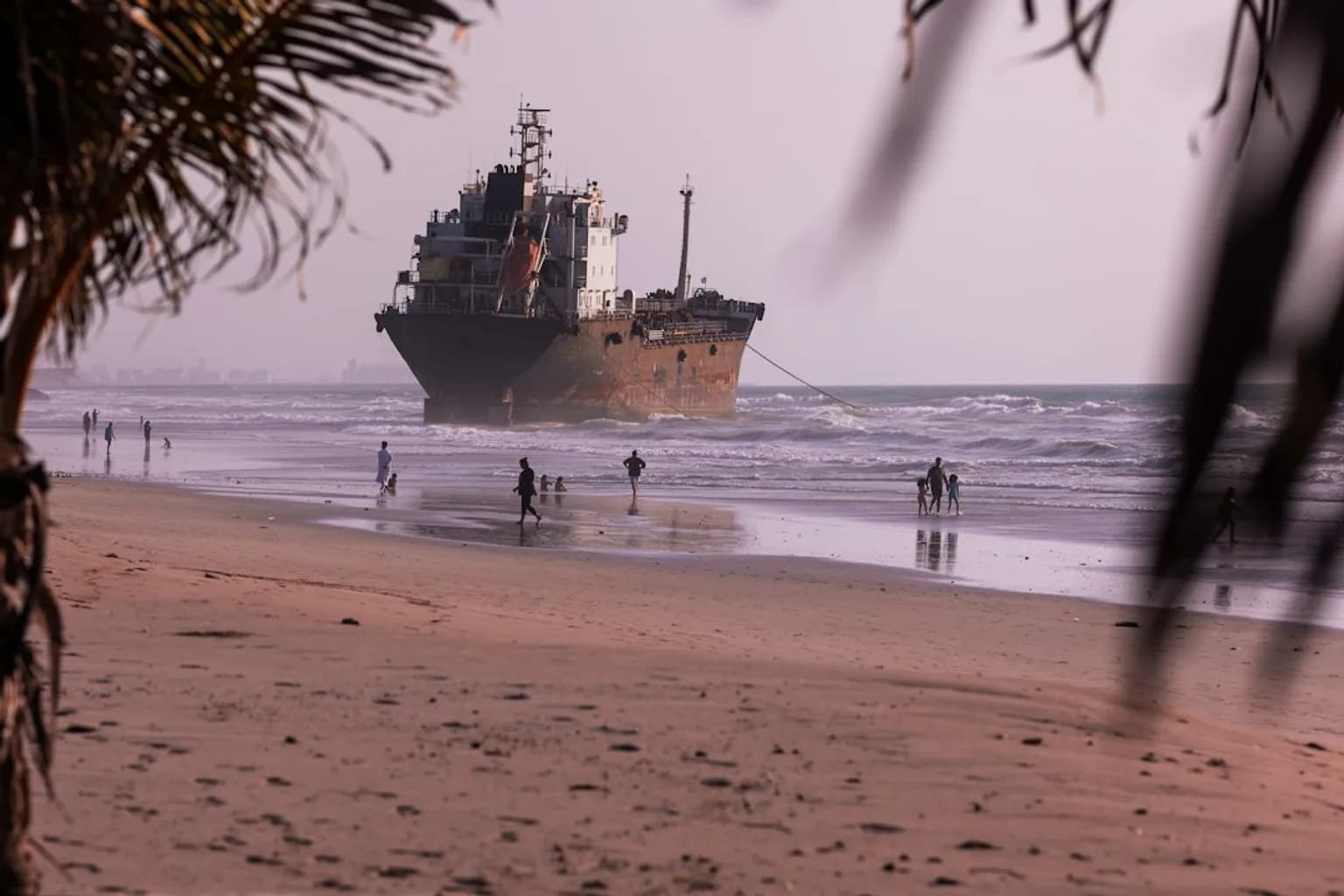
Footage posted on 10 October showed crew members of the Gem No.2 running across its deck and putting on lifejackets as black smoke rose over the vessel. The Panama-flagged, 330-metre crude oil tanker had been struck by an unknown projectile on 9 October, just north of Al Jazeera Al Hamra, setting off a fire that was later extinguished.
International maritime agencies suspect the strike was an Iranian drone attack. The tanker was among a record number of ships that reported attacks in and around the Strait of Hormuz at the start of October.
All 22 Indian crew members were rescued on 11 October.
A small leak was first visible on 19 October. By Wednesday, satellite imagery showed that the slick had travelled more than 35 kilometres from the tanker.
UAE authorities said on Thursday that the incident was affecting beaches near Umm Al Quwain. Verified video from Friday showed oil washing ashore there, turning the water black.
Umm Al Quwain has temporarily closed all beaches and coastal areas. Sharjah authorities also closed Al Hamriya Beach on Friday afternoon as a precaution.
The Ministry of Climate Change and Environment said it had “immediately began containment” to “limit environmental impacts”. Umm Al Quwain Municipality said it was carrying out field operations to contain the spill and reduce damage to marine and coastal environments.
Residents of Dubai and the northern emirates have reported strong fuel odours in recent days. The ministry said the odour posed no health risk.
The spill is extending towards Siniyah and Khor Al Beidah islands, a globally recognised Key Biodiversity Area with corals, seagrasses, saltmarshes, green turtles and the critically endangered Halavi guitarfish.
Prof Steve Widdicombe, director of Sharjah Marine Science Research Centre in the UAE, told BBC Verify that it was “inevitable that there will be an impact”. Eoghan Darbyshire, a scientist at the Conflict and Environment Observatory, called the spill’s closeness to the islands the “most concerning environmental angle”.
Windward, a maritime intelligence firm, identified a leaking tanker about 25 kilometres offshore and projected that currents would take the oil southwest towards Sharjah and Ajman. The projected slick could threaten ports and desalination infrastructure in the northern emirates, although there has been no confirmation of disruption to either.




Comments (0)