

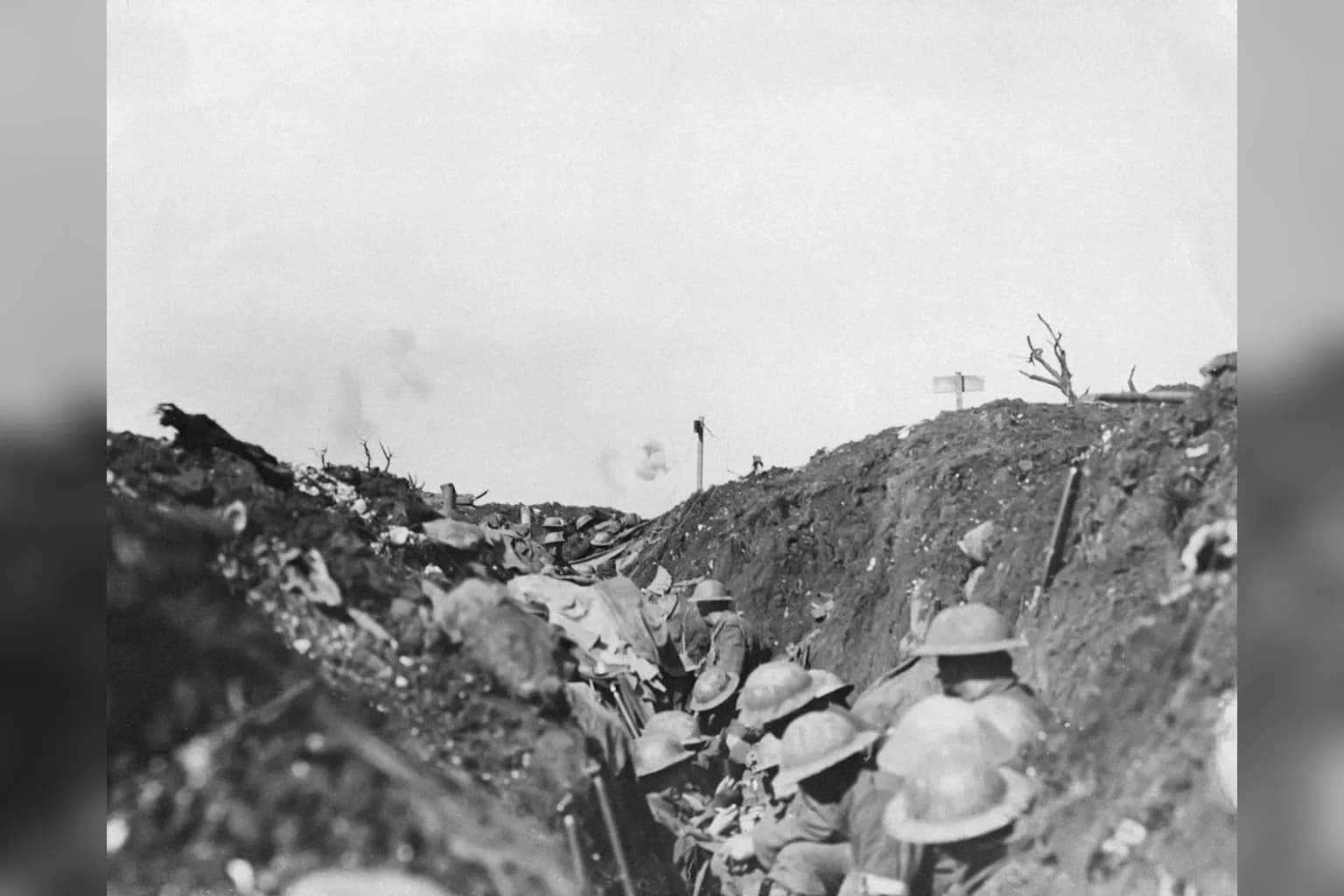
The Order to Stop
British commanders called off their offensive on the Somme on 18 November 1916. The fighting had lasted for more than four months.
The battle had drawn in French, British and German forces.
Other 18 Novembers carry a different kind of decision. Printers, railway companies, telephone engineers, judges and space scientists each put a system into use on this day. How did 18 November bring both the Somme’s final order and new ways to organise public life?
A Date on the Page
William Caxton finished printing The Dictes or Sayengis of the Philosophres at Westminster on 18 November 1477. The work became the first book printed in England to carry a date. Caxton’s book gathered philosophical sayings, and the printed date attached the finished copy to a specific point in time.
Four Clocks for the Railroads
Railroad companies in the United States created four time zones on 18 November 1883. They called the arrangement Standard Railway Time. The companies created it to simplify operations, giving their trains and offices a common way to divide the day.
The four zones were Eastern, Central, Mountain and Pacific. Railway companies in the United States and Canada adopted the arrangement for railway operations. Their networks crossed places with their own local clocks, so a shared schedule gave a departure and an arrival the same meaning along the line.
Caxton had fixed a completed book to a date. The railroads fixed their daily operations to four common clocks. Both changes made coordination visible, first on a printed page and then across railway lines.
A Country Declares Itself
The People’s Council in Riga declared an independent Latvian state on 18 November 1918. The declaration gave Latvia a public claim to statehood. A later account places the proclamation at a meeting in the Latvian National Theatre, where Latvia was declared an independent republic.
Latvia remained independent until Soviet occupation in 1940. It regained independence in 1991. The declaration matters because the country’s later loss of independence and its return to independence both gave the words spoken in Riga a lasting place in Latvia’s history.
The Latvian declaration used a public gathering to establish a political claim. New York audiences encountered a different public debut on the same date, when Walt Disney brought a new character to the screen.
A Mouse Reaches New York
Walt Disney’s Steamboat Willie debuted in New York on 18 November 1928. The film featured Mickey Mouse. Disney gave audiences a character who would become inseparable from the name of his company, beginning with a screening in New York.
A telephone company soon put another familiar public system into people’s hands. Its change rested on the small action of pressing a button to place a call.
The Button That Placed the Call
Bell Telephone began offering the first commercial service for electronic push-button telephones in the United States on 18 November 1963. The service was initially available in Carnegie and Greensburg, Pennsylvania. Bell’s new commercial service replaced the act of dialing with a set of buttons.
The change was simple enough to fit inside an ordinary telephone call. A caller could use electronic push-buttons as part of the familiar task of reaching another person. The date matters because commercial service moved that new method from a technical possibility into use by customers.
Railway time had coordinated movement among trains and offices. Bell’s service changed the way an individual entered a telephone number. A shared system could reach people at the scale of a nation, while its key action took place on a handset.
The Deaths at Jonestown
Members of the Peoples Temple killed U.S. Representative Leo Ryan and four other members of a delegation in Guyana on 18 November 1978. Ryan had travelled there with the delegation. The killings came during the same day as the deaths at the Peoples Temple community in Jonestown.
More than 900 members of the Peoples Temple died by murder or suicide, including the group’s leader, Jim Jones. Another account says more than 900 followers drank cyanide at the People’s Temple Agricultural Project in a mass suicide. The deaths made 18 November 1978 one of the day’s starkest records of a leader’s control over a community.
Jones led the community whose members died in Jonestown. Ryan led a delegation that members of the Peoples Temple attacked. Their actions placed public office and private authority on the same day, with devastating consequences for the people caught in the community.
Jonestown showed the danger inside a group governed by one man’s authority. Twenty-five years later, a court in Massachusetts used a different form of authority to decide who could claim a public legal status.
The Right to Marry
The Massachusetts Supreme Judicial Court ruled on 18 November 2003 that the state constitution protected the right of same-sex couples to marry. The decision placed the question inside the state constitution. Same-sex couples held the constitutional right at issue in the court’s ruling.
The ruling mattered because marriage carries public recognition through the law. The court’s words gave same-sex couples a constitutional claim to that recognition in Massachusetts. Caxton’s dated book had preserved philosophical sayings in print, while this decision used written constitutional language to define a right.
A court can establish a right through a ruling. Spaceflight depends on another form of public organisation, one that carries a person beyond Earth and later sends a craft toward another planet.
Fifteen Minutes in Space
Alan Shepard became the first U.S. astronaut to travel in space when he flew Freedom 7 on 5 May 1961. His mission lasted 15 minutes. Shepard’s flight gave the United States its first astronaut in space, turning the goal of human spaceflight into a completed mission.
A Craft Bound for Mars
NASA launched the Mars Atmosphere and Volatile Evolution spacecraft from Cape Canaveral, Florida, on 18 November 2013. The mission, known as MAVEN, left Earth with Mars as its destination. Its launch turned a planned scientific mission into an active journey through space.
MAVEN entered Mars orbit in September 2014. That arrival gave the launch its result: a spacecraft sent from Cape Canaveral reached orbit around another planet. The journey extended the day’s pattern of organised action farther than any railroad timetable or telephone network could reach.




Comments (0)