

The answer she gave
In 1919, a reporter asked Madam C. J. Walker about the impression that her company claimed to straighten hair. Walker answered with care, saying, “Right here let me correct the erroneous impression held by some that I claim to straighten the hair. I deplore such impression because I have always held myself out as a hair culturist.” Then she came to the line that carried the whole argument: “I grow hair.”
That answer came from a woman whose own hair loss had set her on this path, and whose business had grown into a network of women trained to earn in their own communities. The product sold a promise about hair, while the company offered work, training and a public role to the women who carried that promise. How did Sarah Breedlove turn a hair remedy into power for Black women?
Work came early
Sarah Breedlove was born on December 23, 1867, in a one-room cabin on a cotton plantation in Delta, Louisiana. Her parents, Minerva and Owen Breedlove, had been enslaved on the plantation, and Sarah was their first child born into freedom. By the time she was five, she had learned to carry water to field hands and plant cotton seeds, tasks that placed work at the center of childhood. Both parents had died by the time she was seven.
Sarah went to Vicksburg, Mississippi, with her older sister Louvenia and Louvenia’s husband, Jesse Powell. Reconstruction was ending, and racial terror was rising in the city and across the region. Sarah later described Powell as cruel in ways that suggested serious abuse, while the household demanded that she contribute economically at an early age. She was eleven when Powell required her to bring in money.
Laundry became one of the ways she did it. For a dollar a week, she washed white people’s clothes with strong lye soap, wooden sticks and washboards. The work was punishing, yet it taught her a durable commercial lesson: women with money paid for a service, and repeat customers could become a base for independent work. Her years as a laundress helped her develop clients of her own.
Sarah married Moses McWilliams at fourteen and gave birth to their daughter, Lelia, at seventeen. McWilliams died in 1887, leaving Sarah a young widow, and she later moved with Lelia to St. Louis, where her brothers worked as barbers. In St. Louis, she continued washing clothes, at times earning as little as a dollar a day. The city also put her close to people who made hair care their business.
A problem on her scalp
Severe scalp ailments and hair loss troubled Sarah in St. Louis. She later told a reporter that God answered her prayer through a dream in which “a big black man appeared to me and told me what to mix up for my hair.”
She also learned from women already selling treatments to Black customers. In 1903, Sarah met Annie Pope, a Black hair-care entrepreneur who gave her a treatment called Wonderful Hair Grower; Sarah became one of Pope’s sales agents after seeing how well it worked. She also sold products for Annie Turnbo Malone, whose hair-care company employed women as agents. Sarah worked for Malone before developing her own products.
$1.50 in Denver
Sarah arrived in Denver in 1905 with Lelia and $1.50 in savings. She had a scalp ailment, experience as an agent and a daughter who would soon help run the enterprise. Denver gave her room to build around those assets, though every sale still had to be won one customer at a time.
Her remedy placed her own experience at the center of the sale. Walker later said, “Some of the remedy was from Africa, but I sent for it, mixed it, put it on my scalp and in a few weeks my hair was coming in faster than it had ever fallen out.”
Charles J. Walker, a newspaper advertising salesman whom Sarah had known in St. Louis, became part of that effort. She married him in January 1906 and began calling herself Madam C. J. Walker early that year. The new name had the authority of a title and the usefulness of a brand, while Charles’s work connected him to advertising and Black newspapers. He helped her create advertisements and encouraged the name Madam C. J. Walker.
Within six months of the marriage, Walker chose independent work as a beauty culturist and ended her connection with Annie Pope. She opened a Denver salon in the summer of 1906, while Lelia took charge of the mail-order operation. Customers could meet the business at the salon, learn of it through an agent or receive its products through the post. Walker had built several routes from her preparation to a customer.
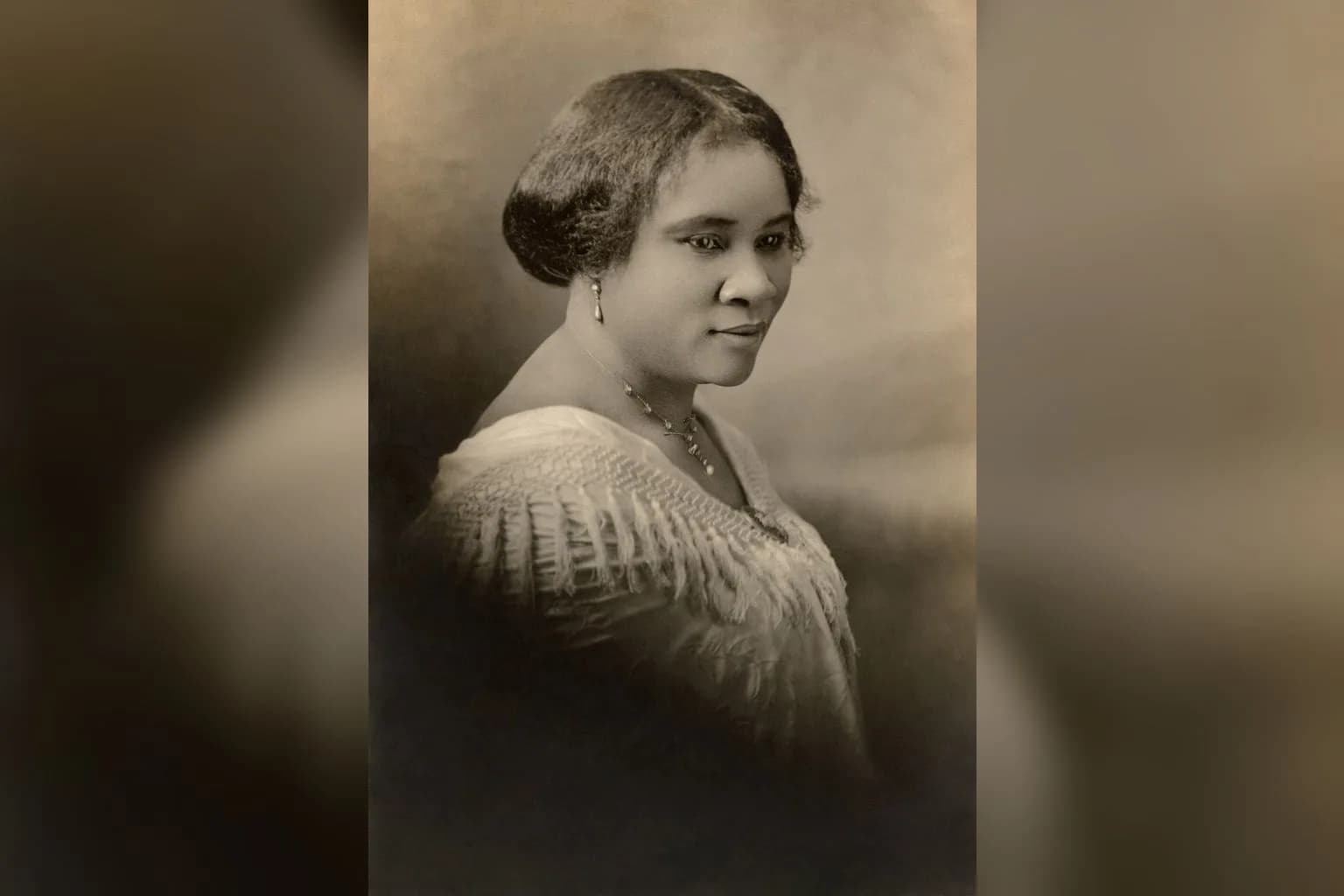
The clearest route was a small can. Her top-selling product, Madam C. J. Walker’s Wonderful Hair Grower, came in a two-ounce container whose lid showed an African-American woman with thick, flowing hair. The woman was Walker herself. The portrait joined the promise of healthy hair to the founder’s own face.
Wonderful Hair Grower belonged to a line that also included a vegetable shampoo, giving customers a set of products rather than a single purchase. The can kept Walker’s likeness in the customer’s hand, and its small size made the sale concrete. A woman could see the thick hair on the lid, hear the agent’s explanation and take the treatment home with the founder’s face attached to it.
Training the women who sold it
Walker moved to Pittsburgh in 1908 and established Lelia College, a training facility for women who would work in the company. The school gave her business a way to multiply its reach. A woman trained in the methods could serve customers in her own neighborhood, sell the preparations and bring another woman into the work.
Walker’s trainees learned a method, then carried it into their own communities as stylists and sales representatives.
Walker shifted the headquarters to Indianapolis in 1910 and established the Madam C. J. Walker Manufacturing Company there. The company manufactured hair-care products and trained women as hair stylists and sales representatives. Its system included shampoo, a pomade presented as helping hair grow, strenuous brushing and iron combs. Each part gave agents something practical to teach alongside the product.
Lelia’s work kept pace with her mother’s ambitions. She ran the day-to-day Pittsburgh operation after the Indianapolis move, and in 1913 she urged Walker to establish an office and beauty salon in Harlem. The company’s expansion depended on women doing visible work: keeping mail orders moving, teaching customers and making the name on the can familiar from city to city. Lelia coaxed her mother to open the New York branch.
In Pittsburgh, she handled day-to-day operations while her mother established the Indianapolis headquarters. Her push for Harlem extended that pattern: she saw a place where the company could open a salon and office, then urged her mother to put the business there.
The jobs held a larger appeal because they were work women could direct in their own communities. Nancy Davis, curator emeritus at the Smithsonian’s National Museum of American History, said Walker “created educational opportunities for thousands of black women and provided them jobs and careers, and opportunity to make money, and to make money in their own community.” The company sold preparations and cultivated careers.
One Walker Agent described the difference in terms of income and access. Walker, she wrote, “opened up a trade for hundreds of colored women to make an honest and profitable living,” where they could earn in one week as much as a month’s salary from another position available to a Black woman. The agent measured the opportunity against the work women could otherwise secure.
Her turn from the floor
Booker T. Washington left Walker off the podium at the National Negro Business League convention in 1912. Walker rose from the floor and introduced herself anyway. “I am a woman who came from the cotton fields of the South,” she said. “I was promoted from there to the washtub. Then I was promoted to the cook kitchen, and from there I promoted myself into the business of manufacturing hair goods and preparations.”
Walker continued the introduction by declaring, “I have built my own factory on my own ground!” The claim answered the exclusion in the room with an account of work she had done and a business she controlled. Her speech placed the factory beside the cotton fields, the washtub and the cook kitchen as part of one story.
Her speech turned the work of her life into credentials. The cotton fields came from Louisiana, the washtub from the laundry work that supported her, and the cook kitchen from domestic labor. Then came the phrase that made the account hers: she had “promoted” herself. Washington’s decision to exclude her from the podium gave Walker the occasion to claim the floor.
Five years after that convention, Walker owned and ran the largest Black-owned company in the United States. The speech had named a businesswoman seeking recognition in a room of Black enterprise leaders. The company gave that claim a physical presence in factories, salons, schools, mail orders and the women trained to represent it. Her own ground had become an organization.
A convention with a demand
Walker brought her agents together in 1917 for the first national convention of Walker beauty culturists. The gathering gave the women who sold and taught the company’s methods a chance to meet as a body, and Walker asked them to see their position in public terms. She had told her agents that their first duty was to humanity and expected them to lead in movements serving “our colored citizenship.” Business, in her view, carried a civic obligation.
Walker’s instruction gave the agents a role that stretched from the salon chair to the public life of their communities. The convention brought that role into one room, joining women who had been trained to earn through the company with a common demand they could make together. Their business network had supplied a structure for gathering, and Walker used the gathering to ask the federal government for action.
During the convention, Walker and her delegates sent President Woodrow Wilson a telegram urging federal action against lynching. Their petition said, “We ask, therefore, that lynching and mob violence be made a national crime punishable by the laws of the United States”, through federal enactment or, if needed, a constitutional amendment. Women gathered through a hair-care company had sent a direct demand to the president and Congress.
The scale of the network made that collective action possible. At its peak, the Madam C. J. Walker Manufacturing Company employed nearly 25,000 agents selling hair and skin products throughout the Americas. Wonderful Hair Grower traveled with those agents, and so did the example of an enterprise run by a Black woman who asked its workers to lead in the places where they lived.
The line she chose
Walker died in 1919 at age fifty-one. Her will directed two-thirds of her estate’s future net profits to charity, extending into her estate the same expectation of public responsibility she had placed on her agents. Her company had given women a structure for earning, and her final plans directed future profits toward others.
Her answer to the reporter returns to the beginning of the story because it described the work in its simplest terms. Sarah Breedlove had suffered hair loss in St. Louis, learned to sell treatments through women’s networks, reached Denver with $1.50, and placed her own image on a can of Wonderful Hair Grower. The business made that image useful by pairing it with training, sales work and a wage for the women who carried it.
Walker’s own words supplied the answer. She had “promoted” herself from the washtub into manufacturing, then built a company whose agents could make similar claims of their own. When the reporter asked what her work promised, she chose the concrete line that appeared at the start: “I grow hair.”





Comments (0)