

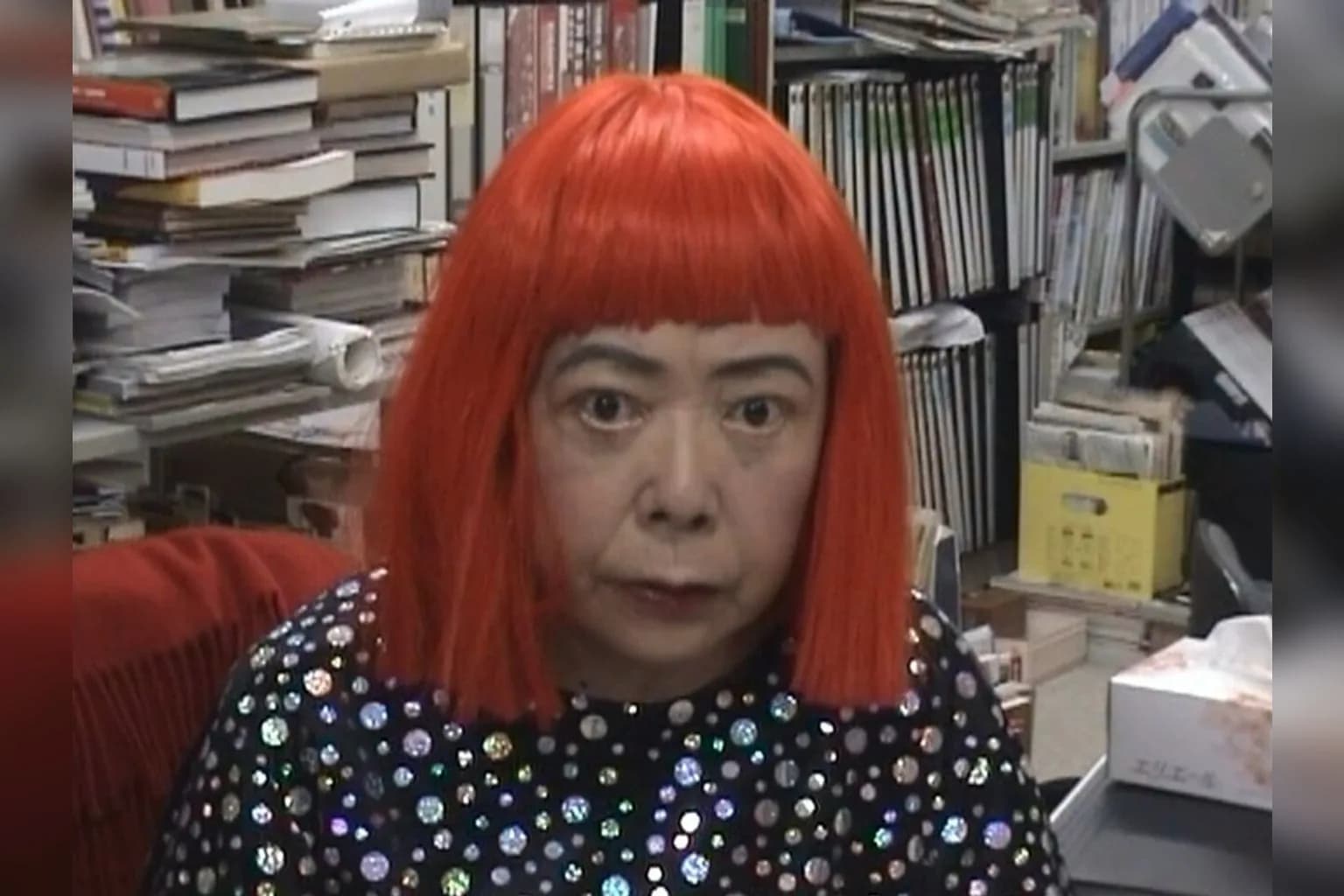
Yayoi Kusama described flowers appearing everywhere: “I see the flowers everywhere, and there are so many, and I feel panicked and become so overwhelmed that I want to eat them all,” she said of the childhood hallucinations that supplied the imagery for her life’s work.
Kusama, whose dots, repeated nets and Infinity Mirror Rooms became among contemporary art’s most familiar images, died in Tokyo on 14 August, aged 97.
Born in Matsumoto, Japan, in 1929, she grew up in a prosperous family that ran a seed business. As a child, she saw flowers swarm around her and patterns of dots and nets cover rooms, her body and the world around her.
At 13, during WWII, Kusama was conscripted to make fabric for Japanese army parachutes in a factory. She later studied Nihonga, the formal Japanese painting tradition, in Kyoto.
She left Japan in 1957 and arrived in New York in 1958. There she made the early Infinity Nets, vast canvasses covered with thousands of repeated marks.
In the 1960s, Kusama took her dots into public space. She staged happenings in which she painted polka dots onto naked bodies, challenging sexual conventions, capitalism and the Vietnam War.
Her first Infinity Mirror Room, “Phalli’s Field”, appeared in New York in 1965. The immersive reflective installations would later draw queues around museums and produce millions of selfies.
Rejection did little to curb her appetite for spectacle. In 1966, after she was refused permission to exhibit in the official Japanese pavilion at the Venice Biennale, Kusama appeared uninvited with Narcissus Garden. She covered a lawn near the Biennale with 1,500 mirrored balls and offered them for sale beneath a sign reading “Your Narcissism for Sale”.
Kusama returned to Japan in 1973. From 1977 onward, she voluntarily lived at a psychiatric hospital in Tokyo and worked for decades in a nearby studio. She continued painting until her final days.
Her work reached audiences well beyond the gallery. A collaboration with Louis Vuitton turned her polka dots into a globally recognisable luxury motif. In 2023, the Nita Mukesh Ambani Cultural Centre brought an Infinity Mirrored Room to Mumbai for the work’s first presentation in India.
That popularity did not settle every part of her public record. Her autobiography, Infinity Net, was published in Japanese in 2002 and in English translation in 2011. In the original Japanese edition, Kusama blamed Black residents and unhoused people for the decline of her New York neighbourhood.
When those comments received renewed attention before her 2023 exhibition at the San Francisco Museum of Modern Art, Kusama said she “deeply regret[ted] using hurtful and offensive language” and apologised for the pain she had caused.
Her view of scale, and of the self within it, remained distilled in one of her best-known remarks: “Our earth is only one polka dot among a million stars in the cosmos”.






Comments (0)