
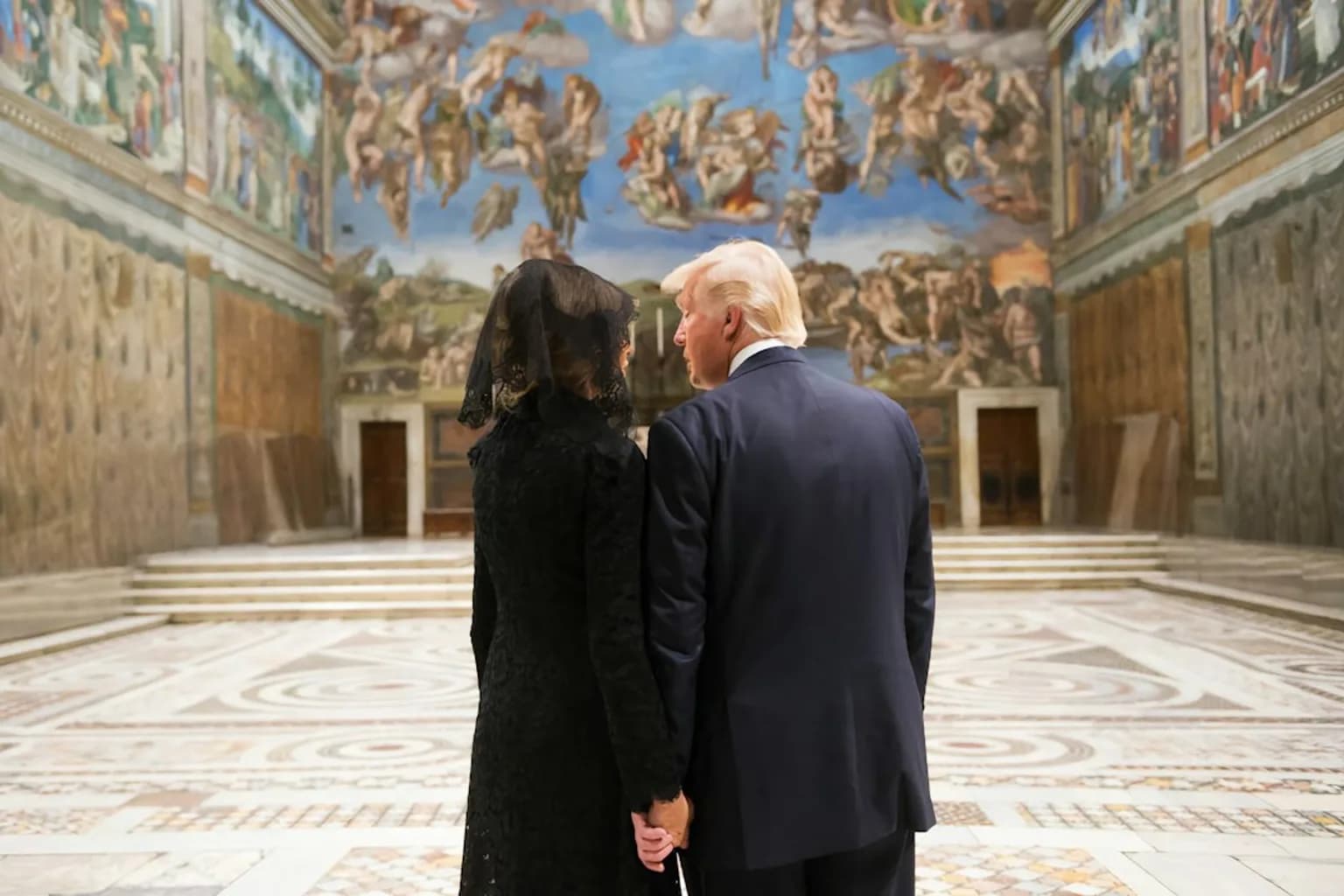
In the White House Rose Garden on Monday, First Lady Melania Trump announced a new federal push on women’s health as she and President Donald Trump signed an executive order together. Trump, who championed and helped shape the order after consulting physicians, White House officials and the president, called the moment a chance to address a longstanding gap in care.
“This is a transformative moment for women in America. Beginning today, we will change the reality of women's health,” she said.
The order establishes a dedicated Women’s Health Division within the National Institutes of Health (NIH) and a White House Women’s Health Task Force. President Trump said he had been surprised that the NIH had lacked such a division, saying: “Think of it: a women's health division, and it hasn't been done, but it's been done under Trump.”
The task force will be led by White House Chief of Staff Susie Wiles and Health and Human Services Secretary Robert F. Kennedy Jr. Wiles recently completed treatment for breast cancer. Kennedy was among those Melania Trump consulted while developing the order.
The task force held its first meeting on Monday afternoon in the Roosevelt Room at the White House. The Department of Health and Human Services will cover its administrative costs, though the order sets no specific funding targets or dollar amounts.
Melania Trump said the order grew out of a need to update women’s healthcare and speed the search for treatments. “It was abundantly clear that women's healthcare needs to be modernized, the research gap closed, and further, the need to accelerate the discovery of treatments and cures was glaring,” she said.
She presented “First Lady's Five Pillars of Women's Health Innovation”, which call for research funding aimed at cures for diseases uniquely affecting women, the use of artificial intelligence (AI) in medical research, faster movement of therapies from laboratories to patients, affordability and access, and wider education on women’s health.
The order directs research towards endometriosis, maternal health, mental health, Alzheimer’s, osteoporosis, heart disease and stroke. Trump told the Rose Garden gathering: “Previous generations fought for women's rights. Our generation will fight to discover the cures that will ensure a woman can live her life in health and to the fullest.”
The NIH must establish the new division within 90 days. It will remain separate from the NIH’s Office of Research on Women’s Health, which it will not replace, and will have a mandate extending beyond research. The order says the division should streamline work on understudied diseases affecting women, advance diagnostic innovation and improve treatment.
The initiative arrives after decades in which women’s health research was underfunded and understudied. A landmark study from 2000 found that women were seven times more likely than men to have a heart condition misdiagnosed or be sent home from hospital during a heart attack. A 2025 review in Science Advances found that historical neglect left women at greater risk of adverse reactions to drugs, more likely to die from undiagnosed stroke and receiving less effective treatments for chronic pain conditions.
In April 2025, HHS moved abruptly to end regional contracts for the Women’s Health Initiative, then the nation’s largest longitudinal study on older women’s health. The NIH workforce is also at its lowest level in decades after thousands of employees were laid off following Trump’s second inauguration. The agency has been told to cut spending by 35 percent across all divisions, amounting to a $2.6bn budget reduction.
In his remarks, the president said: “These are mothers, daughters, sisters, wives, and under the Trump administration, we're going to get them the care and support that they need and deserve.”
In Trump’s second term, the first lady has also focused on foster care systems and technology and AI access in education, following her first-term Be Best initiative.


Comments (0)