

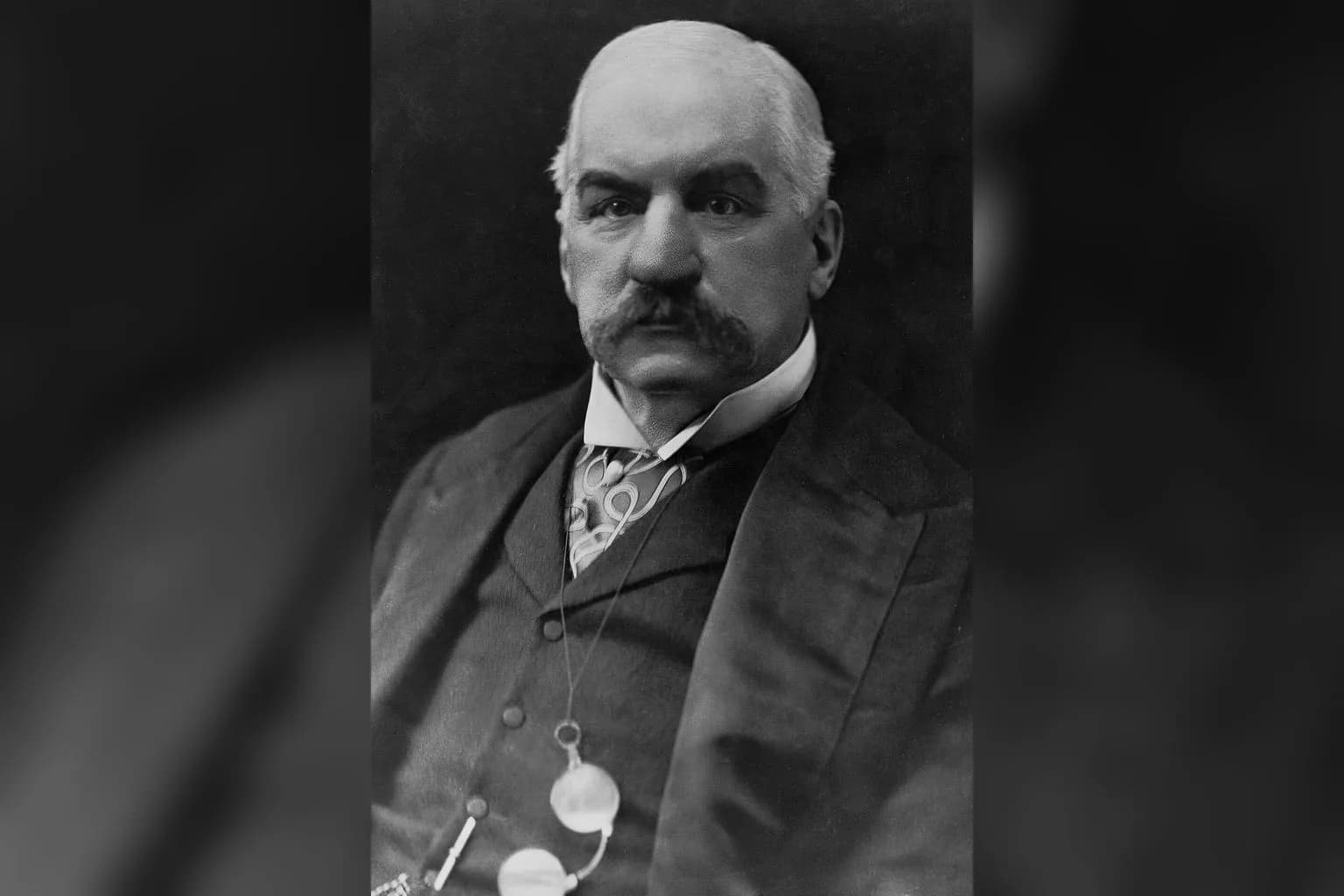
The Books on Morgan’s Table
On Monday, October 21, 1907, Knickerbocker Trust Company asked J. P. Morgan’s rescue group for help. Depositors had begun pulling money from the trust after news linked its president, Charles T. Barney, to the failed United Copper speculation. Morgan asked Benjamin Strong of Bankers Trust to examine Knickerbocker’s books. Strong had only hours to decide whether the company could meet its obligations while depositors demanded their cash.
Morgan had returned to New York after partners sent word that a failed stock-market speculation had brought down two brokerage firms and touched off runs on banks and trust companies. He had been in Richmond, Virginia, attending an Episcopal Church conference when the message arrived. In New York, a private financier now sat at the center of an emergency that reached far beyond one company.
The New York Clearing House had already denied a loan request for Knickerbocker. Its money was reserved for member institutions. Knickerbocker was a trust company, and trust companies stood outside Clearing House membership. Morgan’s group became the trust’s remaining route to large-scale support.
America had no central bank to supply emergency cash. The Banking Panic of 1907 would become the most severe of four national panics in 34 years.
How did Morgan’s private rescue lead America to create a public lender of last resort?
The Copper Deal Breaks
F. Augustus Heinze and Charles W. Morse set the first part of the panic in motion through United Copper. Heinze was a copper magnate from Butte, Montana, who had moved to New York City in 1906. Morse was a Wall Street banker who had previously cornered New York City’s ice market. Together, they held positions across banks, trusts, and insurance companies.
Otto Heinze, F. Augustus Heinze’s brother, began buying United Copper shares aggressively on Monday, October 14. The stock climbed from $39 to $52 in one day. He then demanded that short sellers return the borrowed shares. The plan depended on those sellers needing stock that the Heinzes controlled.
United Copper closed at $30 on Tuesday and fell to $10 by Wednesday, October 16. Heinze and Morse suffered huge losses in the failed effort to corner the stock. Their losses ran through institutions that had become connected to their business dealings.
Charles Barney led Knickerbocker Trust, New York City’s third-largest trust company. News broke on October 18 that Barney was an associate of Morse. The news sparked a run on Knickerbocker, carrying the copper deal from the curb market into the accounts of ordinary depositors.
Trust companies had grown powerful in New York because their charters gave them broad room to invest. Those charters allowed trusts to put money directly into real estate and stock equity investments. National banks faced rules that prohibited those activities.
Trust companies had also grown by offering depositors higher interest rates. Their lighter reserve requirements made those rates possible. The same arrangement left them with less cash when depositors began arriving together.
The Thin Cash Cushion
Knickerbocker’s directors dismissed Barney on October 21 because of his personal connections to Morse. The removal offered depositors no cash. They continued to withdraw funds while Morgan’s group considered whether to step in.
Morgan had sent auditors into troubled firms during the panic to separate institutions that lacked ready cash from institutions that could never meet their debts. A firm with sound assets could survive a run if it received money quickly enough. A firm with deeper losses could consume every dollar sent to it.
Strong could reach no definitive determination in the time available. Morgan refused to aid Knickerbocker after the inquiry. The decision left the trust to meet withdrawals from the cash already on hand.
Knickerbocker’s customers withdrew nearly $8 million before the company suspended operations on October 22. The suspension followed that run on deposits. A failed copper trade had become a crisis of cash, and the crisis was now reaching institutions far beyond the people who had placed the original bet.
Paper Promises
Cash grew expensive as Knickerbocker closed. On October 22, the annualized call-money rate jumped from 9.5 percent to 70 percent. Two days later, it reached 100 percent. The leap in call-money rates showed how urgently borrowers and lenders were competing for funds.
Morgan tried to keep credit moving through the institutions that could still contribute. He solicited cash from large financial and industrial organizations. The money went directly to the loan post at the exchange, where it supported brokers. Morgan’s connections made rapid action possible, though every contribution depended on a private decision.
The New York Clearing House had its own device for emergencies. On Saturday, October 26, its committee formed a panel to facilitate the issue of clearing-house loan certificates. The certificates were temporary debt contracts that Clearing House members could exchange at par value. They helped member banks settle balances and preserved credit within that network.
The certificates ended at the network’s edge. They could settle obligations between Clearing House members, while the public still wanted cash. They could not pass to intermediaries beyond the membership or circulate among the general public. On the same day, Clearing House banks restricted the conversion of deposits into cash, a step that broke the ordinary exchange between a deposit account and bills.
Hundreds of banks remained open by handing out improvised paper i.o.u.s during the crisis. Those paper certificates circulated where cash had become scarce. Communities found ways to keep transactions alive, yet each substitute depended on local confidence and local arrangements.
Across the country, two-thirds of banks entered what one account called an “internecine struggle” for cash. They stopped extending credit to customers. They suspended cash payments. They hoarded the money they held. The panic had turned every bank’s instinct for self-protection into a system-wide shortage.
Samples of a Breakdown
Congress responded in 1908 by assigning the National Monetary Commission to study the country’s banking problems. The commission began its work after a crisis in which banks had restricted withdrawals, improvised paper, and competed fiercely for cash. Its members had to find a structure that could supply money when private institutions all wanted to preserve their own reserves.
Abram P. Andrew, the commission’s secretary, gathered nearly two hundred samples of currencies banks had created during the panic. The collection preserved the paper issued under pressure by institutions trying to continue serving their customers. Andrew’s nearly two hundred samples gave the commission a physical archive of the emergency.
Senator Nelson W. Aldrich chaired the commission. Aldrich had opposed creating a central bank like those operating in other industrialized countries. The panic sent him and other commissioners on a fact-finding tour of monetary systems in London, Paris, and Berlin.
Aldrich brought a Harvard professor to tutor the group during its tour. The commission went abroad looking for the machinery that American banking lacked during the panic. Its work moved the argument from improvised certificates toward a national design.
Aldrich emerged as chief sponsor of the National Reserve Association, a proposal for banking reform. The proposal aimed to create a source of emergency support that could operate across the country. It grew from a practical failure that Morgan’s rescue had made plain: a country of large banks and trusts had relied on a private financier to decide where cash should go.
Meyer Jacobstein, an economics professor at the University of North Dakota, wrote in 1912 urging North Dakota bankers to support the Aldrich plan. Jacobstein saw the association as an answer to recurring banking distress. His appeal also showed how far the debate had moved from Morgan’s urgent inspection of a single trust company.
Aldrich Loses the Argument
Aldrich carried a problem that his proposal could not escape. He was widely seen as the embodiment of the eastern establishment. That reputation left the National Reserve Association politically doomed in large part because Aldrich stood behind it.
The political balance changed with the election of 1912. Woodrow Wilson won the presidency, and Democrats gained majorities in both houses of Congress. The same panic that had elevated Aldrich’s reform plan now provided the problem for a new group of lawmakers to solve.
Carter Glass, the Democratic representative from Virginia who chaired the House Banking Committee, had a banking reform plan in progress by the fall of 1912. He conferred with Wilson before the president-elect entered office. Glass became one of the driving forces behind the legislation that followed.
Glass and Wilson pursued a public institution built for moments when emergency credit was needed. Their design answered the condition that had overwhelmed Knickerbocker. A trust with a small cash cushion had faced a run. The Clearing House had protected its members. Morgan had made a private judgment after Strong could not establish the trust’s condition quickly enough.
The new system would provide a national currency that could expand and contract as needed. It would also serve as a lender of last resort in a crisis. Those two purposes joined the problem of currency to the problem of confidence, since a bank run could become a national panic when cash disappeared from circulation.
A Public Source of Cash
The rate of banking crises in the United States declined markedly after the Federal Reserve System’s creation.
Years later, a Minneapolis Fed account described a different kind of bank rescue during the Depression. Fed officials boarded a small plane with a half-million dollars in small-denomination bills. They flew to a town nearly 200 miles from Minneapolis, where a bank run was underway.





Comments (0)