

The object lifted from the rubble
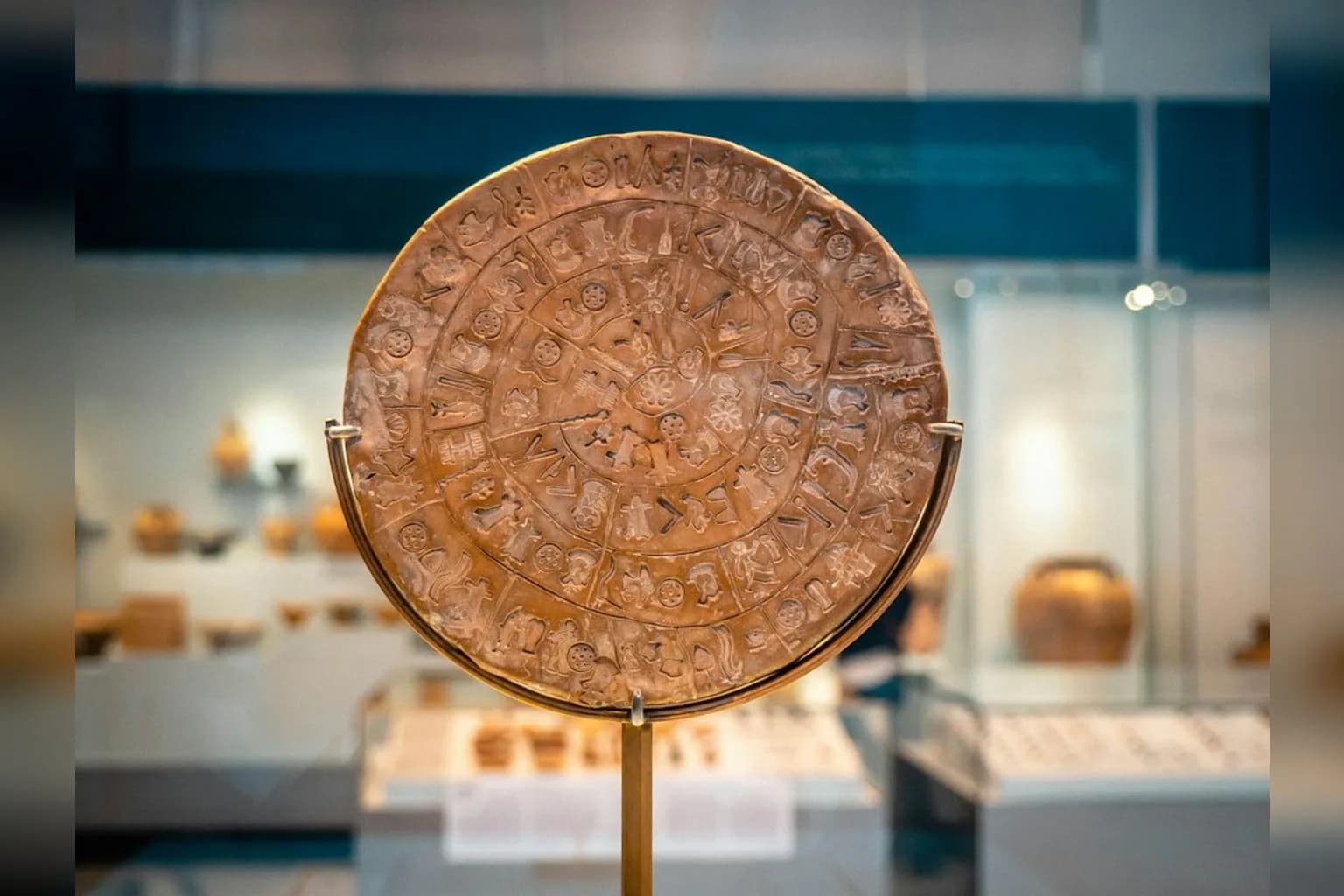
On the evening of July 3, 1908, excavators at Phaistos on Crete’s southern coast brought a small clay disc out of a ruined building near the Minoan palace. The disc came from a deposit of rubble and ashes, and its two faces carried tiny images pressed into spirals before the clay hardened. Luigi Pernier, an Italian archaeologist working with the Italian school of archaeology on Crete, published the find the following year. A Linear A tablet lay nearby in the same deposit, according to an account of the excavation.
The disc is roughly 16 centimetres across and about two centimetres thick, small enough to sit in a hand. Its golden-brown clay holds pictures of people, animals, plants, tools and weapons. A walking figure, a fish, a flower, a shield and a human head with a feathered headdress all appear among its signs. The object now sits in the Heraklion Archaeological Museum, where it has become one of the museum’s most celebrated pieces, as the museum explains.
The disc also carries a problem that has lasted for more than a century. Scholars can describe its clay, its layout and its method of manufacture with great precision. They can count each sign and trace its place in the spiral. They have yet to establish what the inscription says. The Phaistos Disc therefore survives as a documented archaeological find whose message remains beyond a confirmed reading.
The object itself offers a substantial body of evidence. The language behind its pictures offers almost none beyond the object’s own surface. Its maker also used a technique that makes the disc stranger and more legible as an artefact at the same time.
Forty-five punches and a spiral
A single band of signs winds from the outer edge toward the centre on each face. Short scored lines divide that band into 61 groups. Readers often call the groups words, since they look like deliberately separated units. Their ancient function remains unproven, so the neutral term “groups” keeps the evidence in view.
Across both faces, the disc carries about 241 or 242 impressions. Sources differ by one mark because one sign is damaged or unclear. The essential scale is plain enough: the entire inscription contains less material than a paragraph. Those impressions come from a set of 45 distinct signs, arranged in 30 groups on one side and 31 on the other, according to National Geographic.
Its most remarkable feature lies in the way those signs were made. The maker shaped the disc by hand, then pressed prepared punches into wet clay. Each punch carried a single design. The maker could select a punch, press it into the surface, and reuse it wherever the same image belonged in the sequence. The disc then hardened, preserving a process that resembles movable stamps arranged one after another.
The plumed head shows the method especially clearly. It appears more often than any other sign, and its repeated appearances are mechanically identical because they came from the same tool. The uniformity gives researchers a firm basis for counting and comparing the images. It also shows that the inscription was planned through a reusable set of tools rather than drawn freehand onto the clay.
That method has prompted comparisons with printing. The geographer Jared Diamond called the disc “the earliest printed document in the world.” The linguist Herbert Brekle argued that, if the disc is a text, its reusable stamped signs meet the definitional criteria of typographic printing. Both claims concern the manufacturing method rather than the meaning of the inscription, as the account of the disc’s technique makes clear.
The surface also records moments of revision. Researchers have identified places where a sign was erased and replaced before the clay set. Those corrections show a maker working through the sequence rather than merely decorating an object. The disc preserves a composed inscription, even though the language and purpose of that composition remain unresolved.
The tools that created it have disappeared. Archaeologists have yet to recover the 45 punches that would match the disc’s signs. Their absence leaves the disc as the fullest surviving record of this particular sign set. That scarcity becomes the central obstacle for anyone trying to read it.
Why a short inscription resists translation
Decipherment depends on comparison. A proposed sound value gains strength when it works in many settings. A proposed word gains strength when it recurs in patterns that fit a language. A proposed grammar becomes persuasive when it explains a large body of material better than competing ideas. The Phaistos Disc offers patterns, yet its 241 or 242 impressions provide very little room for such tests.
The history of Linear B shows what a successful decipherment usually needs. Linear B also resisted reading for decades. In 1952, the English architect Michael Ventris announced that the script represented an archaic form of Greek. His breakthrough built on statistical work by the American scholar Alice Kober, who had studied repeated sign patterns and their changing endings.
Ventris also had a vast comparative record. Thousands of Linear B tablets from Knossos in Crete and Pylos on the Greek mainland supplied recurring names, formulas and combinations. That large archive let scholars test proposed values across many texts. A reading could survive repeated use or collapse under it, which turned a clever suggestion into a process of verification, according to the account of Ventris’s breakthrough.
The Phaistos Disc has never had that advantage. Archaeologists have yet to find a sufficient parallel corpus written in precisely the same sign system. Linear B offers no established decipherable relationship with the disc’s script, so Ventris’s success supplies a lesson rather than a key. The two scripts belong to the same broad Aegean world, yet their signs have resisted a demonstrated connection.
The 61 groups still offer valuable clues. They reveal repeated images, recurring positions and possible rhythms. They may show how the maker divided the sequence. Yet a recurring group could be a name, a title, a grammatical ending, a ritual formula or something else. The evidence can expose structure while leaving meaning open.
A text looking for a language
Many researchers treat the 45 images as signs in an Aegean-style syllabic writing system. A syllabic system uses signs for spoken syllables rather than individual alphabetic letters. On that view, the disc may represent part of a wider system whose full inventory included more signs than the 45 preserved here. This remains a reconstruction from the disc’s form, since the wider system has yet to appear in a usable body of texts.
Some proposals stay close to the visible pattern of the inscription. John Younger and Paul Rehak observed that groups on side A begin with similar signs while groups on side B end with similar signs. They wrote that the arrangement suggests “repetitious phrases on A and rhyming phrases on B.” Their conclusion allowed for a poem, song, chant or hymn, as Popular Mechanics records.
The suggestion of a hymn has gained wider attention because ritual and poetic language often uses repetition. The Heraklion Archaeological Museum describes a religious text or hymn as the prevailing view, based on what it calls poetic alliteration in some combinations. That is a category of interpretation, not a translation. Repetition can fit a ritual text, and it can also arise in administrative, legal or other formulaic writing.
Other scholars have ventured specific languages and meanings. In 2014, the philologist and archaeologist Gareth Owens suggested that the disc used an Indo-European language related to the Minoan language of Linear A. In 2008, the historical linguist Gia Kvashilava proposed Proto-Georgian and read the text as a dedication to Nana, a fertility goddess from ancient Colchis. National Geographic presents both as theories.
The range of proposed functions reflects the same uncertainty. Writers have described the object as a calendar, a poem, a hymn, a prayer, a sacred text, a treaty, a list of soldiers, a board game and musical notation. Those suggestions demonstrate the interpretive freedom created by a short and isolated inscription. The physical evidence narrows the possibilities of manufacture far more effectively than it narrows the possibilities of meaning.
Authenticity, context and the challenge of doubt
Pernier originally assigned the disc to the Middle Minoan period, in the centuries around 1700 BCE, using pottery from the surrounding deposit. Other scholarly date ranges have run from about 1850 to 1400 BCE. The Heraklion museum places it around 1700 to 1650 BCE, while other reporting gives a range from 1800 to 1600 BCE. These broad ranges arise from archaeological context rather than from a dated inscription on the object itself.
The nearby Linear A tablet and the burned deposit connect the disc with a Minoan setting. They give the find an archaeological context that has remained central to its study. Context also has limits. It can place an object within a period and a site while leaving open questions about the exact moment when it was made, used or deposited.
In 2008, antiquities dealer Jerome M. Eisenberg argued that the disc might be a modern fabrication connected with Pernier. He pointed to its excellent condition, cleanly cut edges and apparent uniformity. Eisenberg also claimed that professional rivalry offered a motive for manufacture. The New York Times archive reported his allegation. Pernier was never charged.
A modern manufacture could explain why its script stands alone. Evidence from testing has moved in the other direction. Thermoluminescence testing and clay analysis have supported the disc’s antiquity, according to Historiqly’s survey of the debate. Those results speak to the age and material of the object. They do not reveal the language preserved on its surface.
Later finds have added another relevant piece of evidence. Researchers have identified signs resembling some of the disc’s symbols on stamped pottery, potters’ marks and Minoan seals discovered at Phaistos decades after the 1908 excavation. Futura-Sciences describes these later parallels as part of the continuing discussion around the object.
What would solve the Phaistos Disc
The spiral still leads from familiar images toward an unknown message. Its maker left behind the marks of repeated tools, deliberate divisions and occasional corrections. The missing world around those marks is what keeps the disc unread. A single future text could transform the puzzle, yet for now the Phaistos Disc preserves one of archaeology’s clearest examples of a message that survives without its key.





Comments (0)