

A Book Sent to Be Read
On 19 August 1666, a Prague physician sent a vellum codex to a Jesuit scholar in Rome. Joannes Marcus Marci addressed the parcel to Athanasius Kircher and enclosed a signed letter dated in Prague. That letter still lies loose with the manuscript, and the NSA’s historical account treats the delivery as the book’s entry into recorded history.
Marci chose Kircher because he believed the Jesuit scholar might read a book that had already defeated others. “This book, bequeathed to me by an intimate friend, I destined for you, my very dear Athanasius, as soon as it came into my possession, for I was convinced that it could be read by no one except yourself,” he wrote. He also reported that Rudolph II had bought it for 600 ducats, according to The New York Review of Books. It also establishes the central puzzle at the moment the record begins: its writing had already become unreadable to its owners.
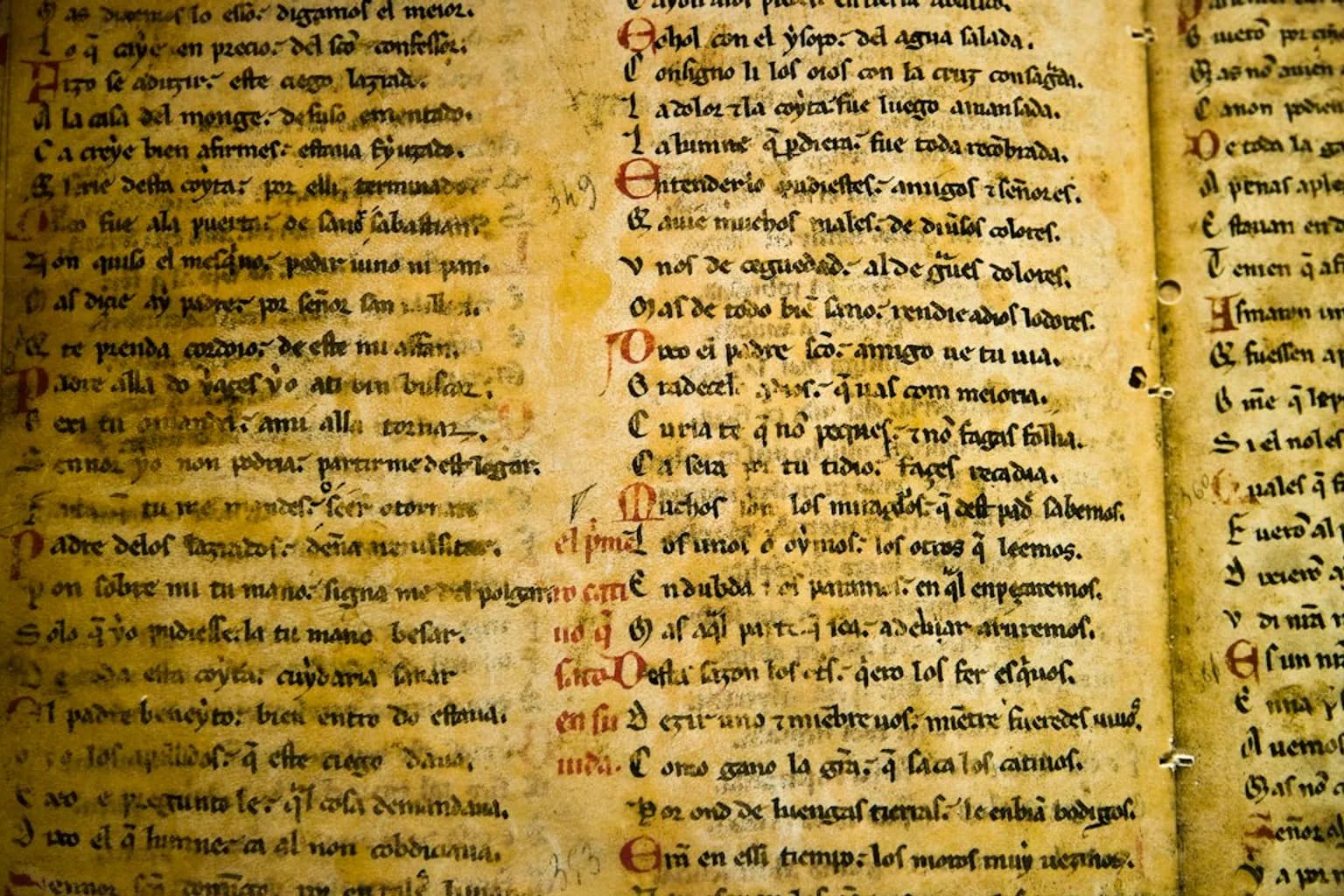
The book contained more than 200 vellum pages. Text in an unfamiliar script covers almost every page. The NSA account describes an object whose alphabet had no known reader, and a definitive decoding has yet to emerge.
Yale’s library catalogue calls the volume the “Cipher Manuscript.” Newspapers usually call it the Voynich Manuscript after Wilfrid Voynich, the rare-books dealer who brought it into public view centuries after Marci’s letter. The Atlantic traces both names to the book’s modern life at Yale.
That life has given the mystery an unusual shape. The author, language and purpose remain unidentified. The object itself preserves evidence about when it was made, how it was assembled, who handled it at certain points, and why one old authorship theory could never withstand the book’s own physical record.
The Object Gives Its First Answers
The Voynich Manuscript is a parchment codex about the size of a hardcover novel. Its visual world begins with large drawings of plants. It expands into celestial diagrams, bathing women, pools and linked vessels. Retrospect Journal describes illuminations on nearly every page, which helps explain why readers have repeatedly searched for botanical, medical and astronomical meanings in the images.
The volume also has eleven larger foldout pages that appear to contain astronomical or astrological diagrams. Its opening 130 pages look like an herbal, with large plant drawings beside extensive text in a flowing cursive hand. The New York Review of Books describes those visible sections carefully as appearances, a useful discipline for a manuscript whose pictures invite interpretation while withholding confirmation.
The materials provide firmer answers. Carbon-14 analysis dates the vellum to between 1404 and 1438. That date range places the physical book in the early fifteenth century.
Material study adds detail to that range. Roughly 240 pages came from at least 14 calfskins, and the ink was added shortly after the skins were processed, according to an overview of the manuscript’s physical study. The book has about 234 surviving pages, while evidence suggests that at least 30 pages are missing. The surviving codex is therefore a substantial remnant of a larger work.
The symbols offer another clue, although they offer no settled translation. Scholars commonly call the script Voynichese. One account describes an alphabet of roughly 20 to 30 distinct characters. The Science Survey presents Voynichese as a practical name for a writing system that remains unidentified.
The handwriting makes any simple story of authorship harder to sustain. Lisa Fagin Davis, a medievalist and executive director of the Medieval Academy of America, used digital paleography to compare the forms of the characters. She concluded that five scribes made the manuscript. Yale Library’s account of Davis’s research identifies that finding as one of the clearest modern discoveries about the codex.
Five scribes, calfskin pages and a dated range give the book a material biography. They leave its words unread. For the next part of its story, the manuscript depends on later traces: a faint signature, a court connection and a letter sent to Rome.
A Traceable Journey, With Long Gaps
Infrared light revealed a partial signature on the manuscript’s first page: “Jacobj à Tepenese.” Researchers identified the mark with Jacobus Horcicky de Tepenecz, director of Emperor Rudolph II’s botanical gardens. Retrospect Journal explains the limited conclusion that follows from the signature.
Horcicky received the title “de Tepenecz” in 1608. He died in 1622. The manuscript is therefore presumed to have been in his possession during that interval, a valuable clue that identifies an owner rather than an author.
The same letter carried an attribution that would shape the manuscript’s modern fame. Raphael Mnishovsky had speculated that Roger Bacon, the thirteenth-century Franciscan scholar, wrote the book. The Science Survey’s account preserves that claim as a speculation relayed by Marci.
Marci sent the codex to Kircher in the hope of a decipherment. After Marci’s death in 1667, Kircher transferred the manuscript to the Jesuit order in Prague. A Jesuit College inventory listed it in 1670, giving the book a further institutional foothold before a long gap in its documented trail.
Voynich’s Discovery Created the Modern Mystery
The manuscript returned to view through a Jesuit sale. In 1903, the Society of Jesus decided to sell part of its assets after financial hardship. The holdings included hundreds of books and manuscripts from the library of the Noble College of Mondragone, a Jesuit institution at Villa Mondragone. The sale took place in 1912. The Science Survey describes the circumstances that brought the book back into the market.
Wilfrid Voynich, an antiquarian bookseller, acquired the codex from the Jesuit collection at the Nobile Collegio Mondragone in Frascati. He purchased about 30 books and manuscripts from the Jesuits. Among them sat a manuscript filled with dense unknown writing, striking illustrations and a letter that linked it to famous figures in European learning.
Voynich brought the manuscript to public attention in 1915. He hoped to find a buyer willing to pay as much as $100,000. Accounts of his campaign show how the book’s obscurity became part of its commercial appeal.
He retained the manuscript until his death in 1930. It passed to his wife, who bequeathed it to Anne Nill, their assistant and friend. Nill sold the book to Hans P. Kraus in 1961, and Kraus donated it to Yale’s Beinecke Library in 1969. The New York Review of Books records Kraus’s purchase and his later gift to Yale, where the volume is catalogued as Beinecke MS 408.
The journey matters because it is unusually well documented once Voynich acquired the book. Yale now holds the manuscript for public study. The library has scanned and published the entire document in its digital library, and more than 150,000 online users searched for it through Yale Library Digital Special Collections during 2024. Yale Library ranked it as the collection’s third-most-popular search that year.
Voynich also turned the old Bacon speculation into a public decoding campaign. He sought help from William R. Newbold of the University of Pennsylvania, and the two toured the book across America as the “Roger Bacon Cipher Manuscript.” That name gave the mystery a famous proposed answer. The parchment date supplied the evidence that answer could not survive.
The First Famous Solution Failed the Date Test
Newbold developed a complex method using microscopic markings that he treated as the basis for reading the text. His complete analysis, The Cipher of Roger Bacon, appeared two years after he died in 1926. The Science Survey traces both the method and the posthumous publication.
Newbold’s procedure had a second historical problem. It relied on microscopic features, and the microscope arrived three hundred years after Bacon’s death, according to the reporting on the theory. The Bacon attribution thus failed on the manuscript’s material date and on the historical requirements of Newbold’s method.
That failure created a useful standard for later proposals. Any convincing reading must fit the known date of the object. It must also show how marks on the page become words and meanings that other researchers can examine. The manuscript has attracted many theories. Its physical record keeps every theory answerable to the same evidence.
Language, Cipher, Hoax: Theories Without a Verified Reading
The script offers a strong reason to continue looking. Its alphabet follows patterns associated with natural language, especially Zipf’s law. Sandpoint Reader’s overview identifies that statistical feature in the text.
Zipf’s law describes a recurring distribution in which a small number of words appear very frequently while many others appear less often. In Voynichese, that pattern makes the writing look structured rather than randomly scattered. It has yet to provide an agreed dictionary, grammar or translation.
Leonell C. Strong, a Yale cancer researcher, advanced a medieval-English theory in 1945 and again in 1947. He believed the book concerned women’s health and herbal remedies. Retrospect Journal records the proposal, whose themes drew encouragement from the manuscript’s plants and bathing figures.
Robert S. Brumbaugh, a Yale professor, proposed a different explanation. He claimed that the manuscript was a forgery intended to extract a large payment from Rudolph II. He also asserted that Roger Bacon’s name appeared within the text.
Computing has supplied further paths. Greg Kondrak and a graduate student at the University of Alberta fed the Voynich Manuscript into an A.I. database, which concluded that the text was likely written in Hebrew. They used Google Translate to identify words. Independent researchers Doireann Herold and Caira Andrade are exploring possible links to Irish through Filidh scholar materials from the same period. The survey of proposed readings places Hebrew and Irish among the latest suggested directions.
The Solvable Mystery Inside the Unsolved One
That effort now has a collaborative form. In 2022, computer scientists and other specialists formed the Voynich Research Group.
Davis has described the value of working from the object itself. “It’s an actual object, it exists in space and time, it has a history, it has physical characteristics, and because of that, it has a true story,” she said. “We just don’t know what that true story is yet.” Her formulation for Yale Library captures both the progress and the remaining boundary.
The book’s strongest documented history is material and custodial. It runs from early-fifteenth-century vellum through a seventeenth-century letter, Jesuit custody, Voynich’s purchase and Yale’s library. The missing translation remains the central mystery. The pages have supplied a different kind of answer: they show how much can be known when every claim begins with what the object can actually bear.




Comments (0)