

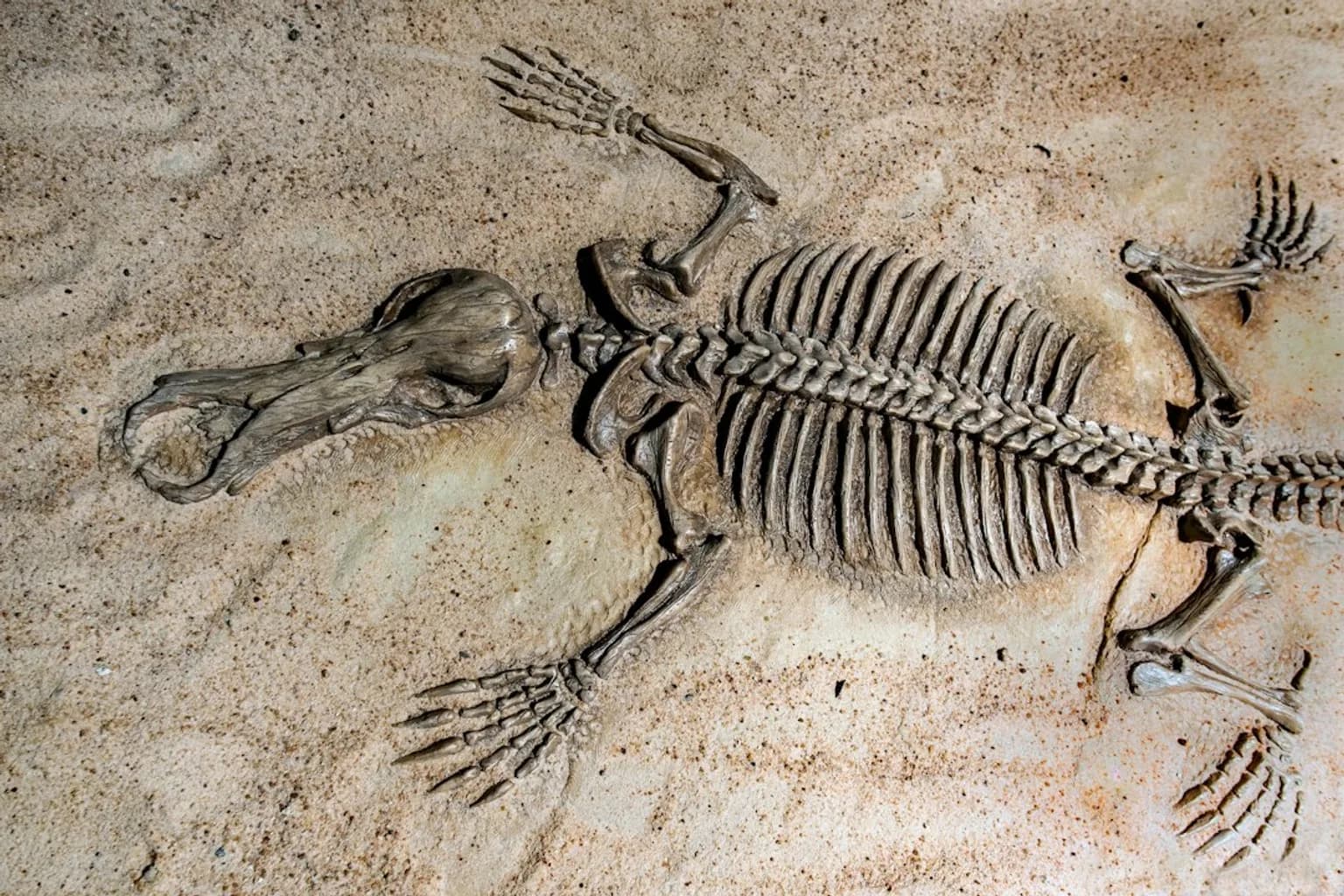
Kliti Grice cut thin sections from a dinosaur bone, fixed them to glass slides and used hydrochloric acid to clear away surrounding rock. Under an electron microscope, her team saw small round structures in channels that once carried blood vessels through the bone.
The international team led by Grice at Curtin University says the structures are mineralised red blood cells from a 115-million-year-old leg-bone fragment of Aratasaurus museunacionali from Brazil. Chemical analyses also detected heme-derived molecules and amino acids associated with collagen.
In one slide, just a fifth of a millimetre wide, the researchers counted 20 of the structures they identify as blood cells.
“I was jumping up and down,” Grice said. “I ran up to my head of school's office and was so excited that he gave me a whisky to calm me down.”
The team’s study was published in Proceedings of the National Academy of Sciences on 2 November 2026. Grice said it marked the first finding of fossilised red blood cells with chemistry linked to heme in situ in any fossil.
Heme is the organic compound that enables haemoglobin to carry oxygen around the body. The tests also found building blocks of collagen, a protein found in connective and other tissues.
The fossil was collected from a mine in Brazil in 2008 and held at the National Museum of Brazil before the analysis. Aratasaurus was a small meat-eating dinosaur, approximately 3 metres long and about 34 kilograms in weight. It was still growing.
The researchers found the structures mineralised with hausmannite, a manganese compound. They say the mineral may have stabilised the cells before fossilisation, although the mechanism remains unclear.
Grice said the work is the first study to use chemical processes to identify heme-based signatures in dinosaur bones. “Any extraordinary claim needs extraordinary analytical evidence. The aim isn't to find Jurassic Park DNA, it's to determine how much genuine molecular information deep time can preserve.”
The identification remains contested. Mary Schweitzer, a molecular paleontologist at North Carolina State University, said dinosaur blood cells should have a “nuclear bulge” and look dome-like on both sides. The structures reported by Grice’s team are concave.
Bird and reptile red blood cells retain their nuclei, unlike mammalian red blood cells, which lose them during development.
Schweitzer said: “The conventional wisdom in palaeontology that all endogenous organics would disappear in a million years or less is being routinely challenged, and will continue to be as technological approaches to palaeontological specimens are more routinely applied.”
Reports of red blood cells have previously come from a 75-million-year-old bone fragment collected in Canada in 2015 and from the femur of a Tyrannosaurus rex that died 68 million years ago and was found in Montana in 2005.
The new work adds chemical evidence to the debate over what fossils can preserve. Whether the round structures are definitively red blood cells, and how widely such preservation occurs, remain unresolved.



Comments (0)