

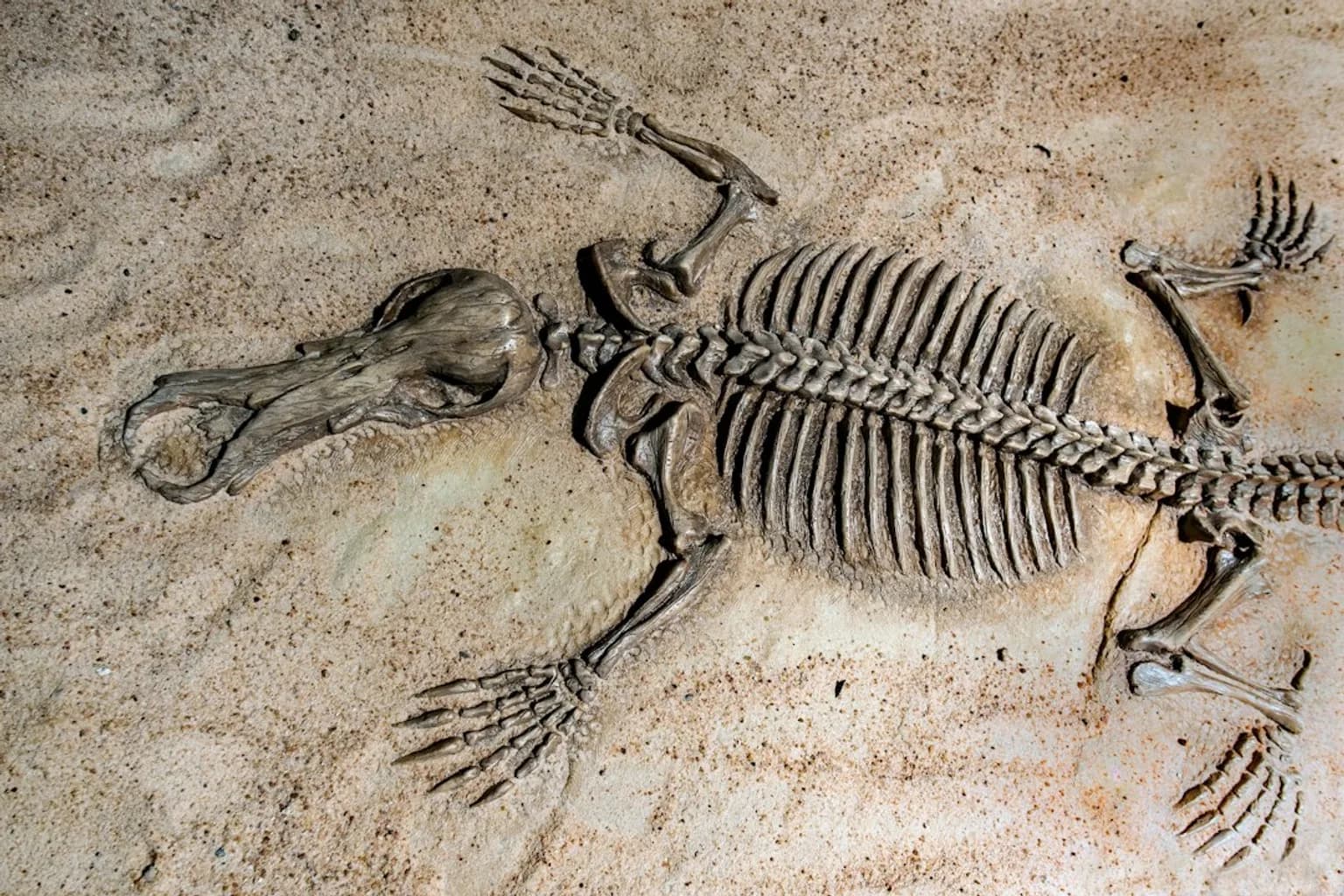
Farmers found two nearly complete skeletons in what is now a national geopark in Guanling county, China. The fossils came from a zone of Guizhou province once covered by ocean, hundreds of kilometers from large continental masses and at least 30 kilometers from possible islands.
The specimens were near-perfect and exquisitely preserved. They belonged to Gerrothorax maritimus, a primitive amphibian from a group called temnospondyls that lived 237 million years ago during the Late Triassic period.
At 74 centimetres long, Gerrothorax had a flattened body, four legs and gills. It was almost completely covered in body armour.
The animal lived on the ocean floor as a bottom-dwelling ambush predator. Its wide mouth and strong hyoid bone in the neck suggest it fed by suction, drawing in prey that came within reach.
It also showed no evidence of metamorphosis, remaining fully aquatic throughout its life.
The strongest evidence for a life at sea came from the bones. Scientists found that strontium isotope levels in Gerrothorax matched those in seawater at the time.
The researchers wrote that the animals “grew up drinking the seawater”.
Ryosuke Motani, a palaeobiologist at the University of California, Davis and the study’s corresponding author, worked with scientists from Peking University and the Geological Museum of Guizhou on the research. Their findings were published in Nature Ecology & Evolution on 26 October 2026, identifying Gerrothorax maritimus as the first known fully marine amphibian.
The conclusion runs against the prevailing explanation for why amphibians stay out of the sea. Permeable amphibian skin was thought unsuited to marine life because it would absorb too much salt from sea water.
There are more than 8,000 modern amphibian species, and none lives exclusively in a marine environment. Less than 2% can adapt to brackish habitats where freshwater and seawater mix.
The researchers say Gerrothorax’s bony armour limited water and salt exchange through its skin. That arrangement favoured the use of gills and digestive apparatus that could develop a greater tolerance for salt.
Steve Brusatte, a palaeontologist and evolutionary biologist at the University of Edinburgh, UK, said: “If this Triassic amphibian, Gerrothorax, really was fully marine, then it is a game-changer.”





Comments (0)