

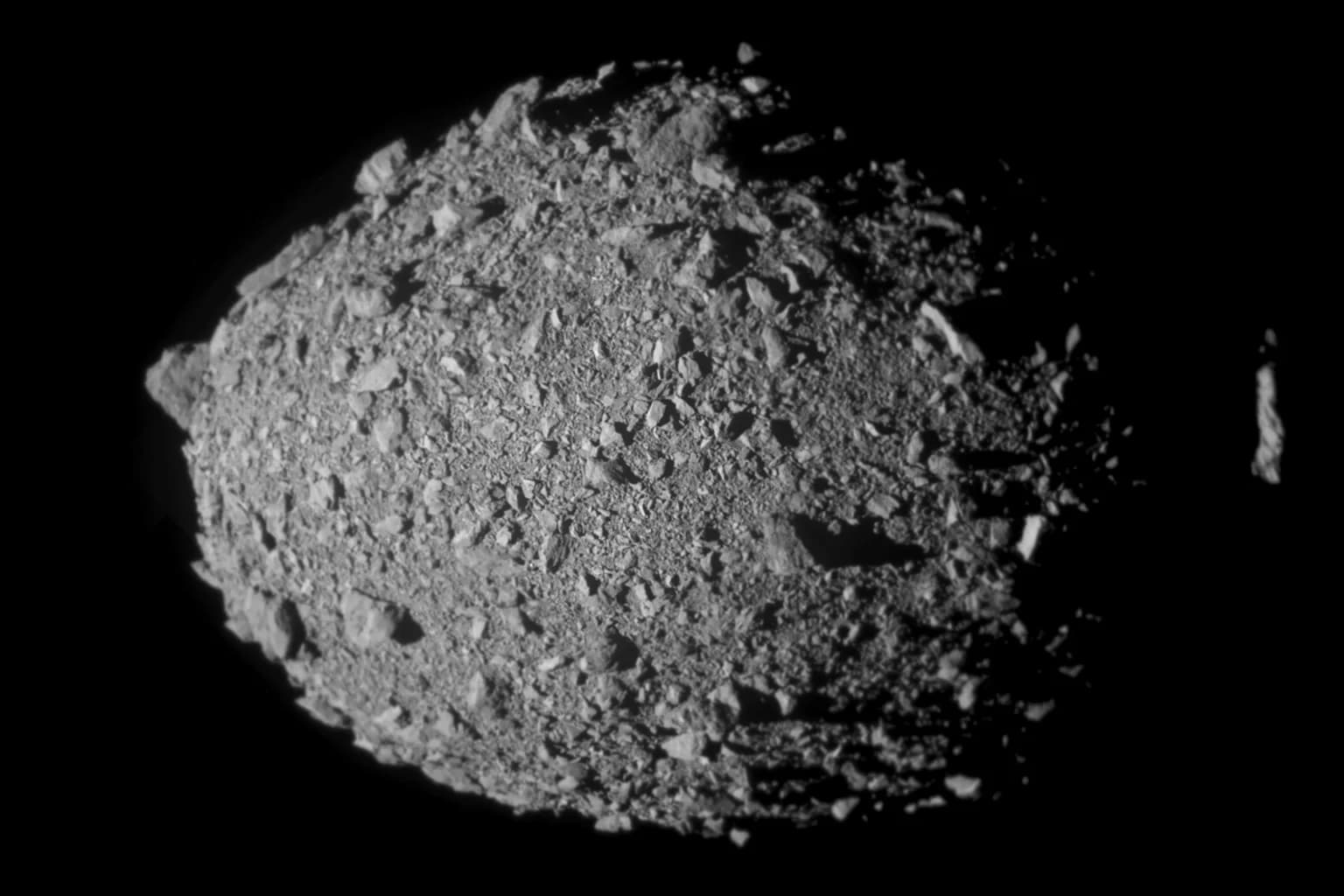
When the European Space Agency revealed Hera’s observations on Wednesday, 25 November at the Museum für Naturkunde Berlin in Germany, Patrick Michel, Hera’s principal investigator and Director of Research at the Observatoire de la Côte d'Azur, described the result of the impact in striking terms. “the face struck by DART has been flattened into an impact crater the size of a sports stadium, extending across the asteroid's entire width,” he said.
NASA’s DART spacecraft deliberately crashed into Dimorphos on 26 September 2022 to test whether an impact could alter an asteroid’s trajectory. Dimorphos is a small moonlet of the much larger asteroid Didymos. Dimorphos is 151 metres wide, while Didymos is 730 metres wide, and neither posed a threat to Earth.
The collision changed the Dimorphos-Didymos system’s orbit around the sun by 33 minutes and left Dimorphos tumbling in its orbit around Didymos. Michael Kueppers, Hera’s mission scientist, said the impact had left the moonlet “tumbling wildly in its orbit.”
Hera launched in October 2024 and travelled 120 million miles to the Didymos system. The probe is now in a rectangular orbit around the asteroid pair at a distance of around 30 kilometres, where it captured the first detailed images of the crater.
From 25 to 30 kilometres away, Hera used a monochrome camera, a multispectral imaging system and a thermal infrared imager to observe the impact site. Both Dimorphos and Didymos are surrounded by hundreds of orbiting boulders just a few metres in size. Boulder fields in areas of Dimorphos outside the impact zone look the same as they did in DART images from 2022.
Hera will come within around 13 kilometres of the asteroids for higher-resolution images. In early 2027, it will deploy two shoebox-sized craft, Juventas and Milani. Juventas, created by a Luxembourg-led research team, will use low-frequency radar to probe Dimorphos’s interior and will eventually attempt to land on the asteroid. Milani, created by an Italian-led team, will prospect asteroid dust and other surrounding materials.
The work addresses a central question for planetary-defence planners: how asteroids respond to an attempted deflection. NASA and other space agencies are exploring changes to asteroid orbits as one possible way to protect Earth from potentially dangerous future impacts. Ian Carnelli, Hera’s mission manager, said the two missions together meant “humanity is taking a decisive step towards making asteroid deflection a reliable tool for protecting the planet.”
The combined data from DART and Hera will inform future strategies for protecting Earth from potential asteroid impacts.




Comments (0)