

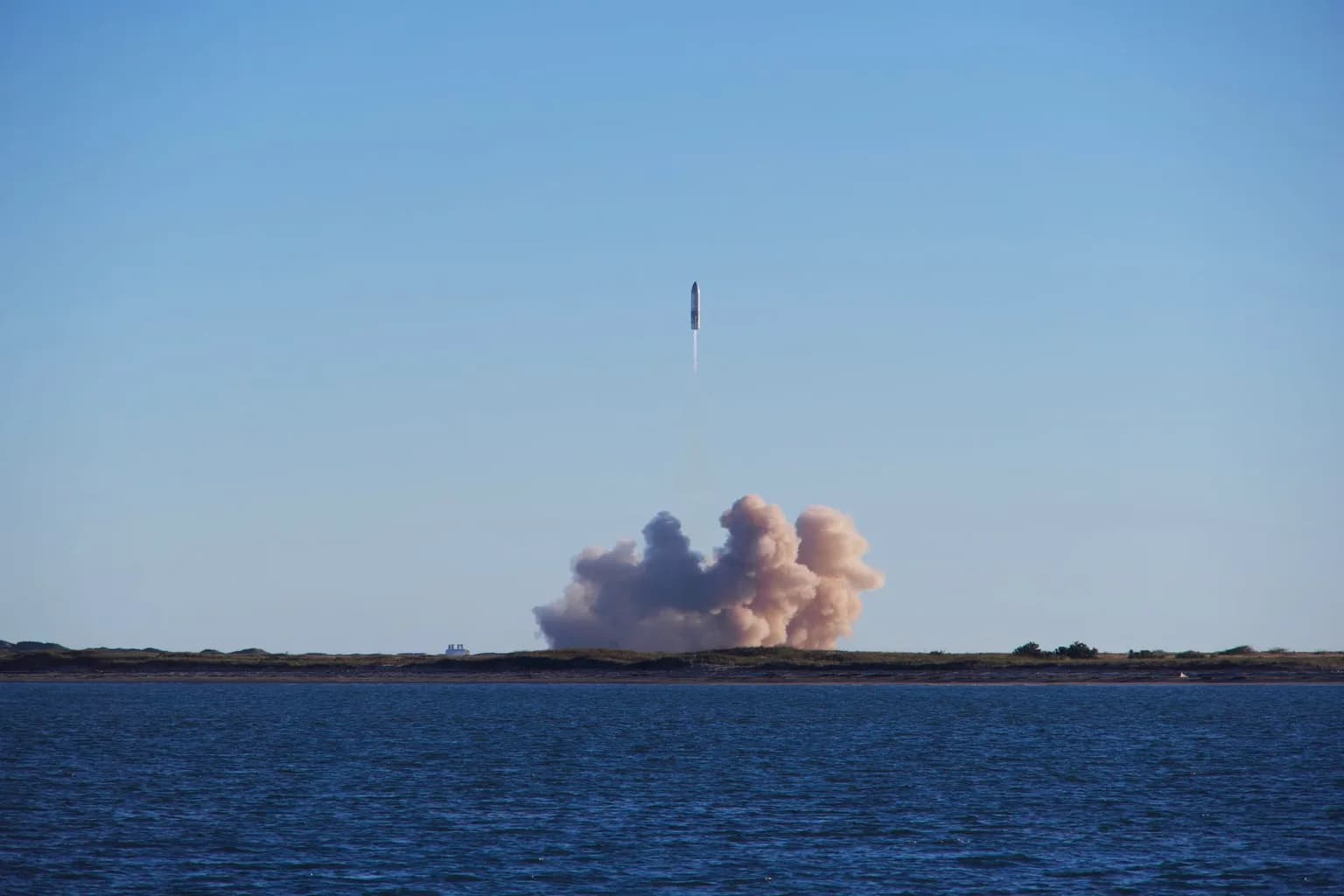
At 04:41 local time on 20 October, a Japanese spacecraft lifted off from JAXA’s Tanegashima Space Center on a mission to bring part of Phobos back to Earth. It is the world’s first mission dedicated to collecting and returning samples from the Martian moon.
The Mars Moons Exploration, or MMX, mission is led by the Japanese Space Agency. If its return capsule succeeds, it will mark the first time material from Mars or either of its moons has been brought to Earth for laboratory analysis.
For Yasuhiro Kawakatsu, the project manager, the task lies on what he called the solar system’s “most important unclimbed mountains”. Mars’s moons have potential importance, he said, yet have never been fully investigated.
The spacecraft is due to travel 500-600 million km to reach Mars and Phobos in August 2027. It will first study Deimos in the Mars neighbourhood, then concentrate on Phobos for three years, gathering data and attempting to collect samples before heading home in 2031.
Phobos is about 20km (12 miles) across, while Deimos is about 10km (six miles) across. Phobos circles Mars at about 6,000km (3,700 miles), three times a day, and measures about 27km (17 miles) at its widest point. Mars acquired the two moons about 4.5bn years ago.
The central question is where they came from. Scientists think Phobos and Deimos either formed from debris after a space rock struck Mars or began as asteroids from the outer Solar System that Mars captured through gravity. Kiyoshi Kuramoto, MMX’s principal investigator, said soil analysis could almost certainly provide a definitive answer.
MMX plans to set down a small French-German rover, Idefix, on Phobos to explore its terrain during a 100-day mission in around 2029.
Sample collection is targeted for no earlier than December 2028. The mission will attempt to gather at least 10 grams of material from Phobos through US and Japanese sampling methods. The stated amount due to return is 10g. Japan’s coring method will take soil from a depth of about 2cm, while the Pneumatic Sampler, or P-Sampler, will use bursts of high-pressure nitrogen gas.
NASA is providing the Mars-moon Exploration with Gamma rays and Neutrons, or MEGANE, spectrograph, the P-Sampler technology demonstration, and communications and navigation assistance through the Deep Space Network. The agency will receive and curate about 15% of the returned sample at the Johnson Space Center Astromaterials Lab in Houston.
The sample is expected to contain about 0.1% material from Mars itself. Measurements of its chemical composition, together with MEGANE’s observations, are expected to determine whether the moons came from impact debris or captured asteroids.
The material will be sealed in a small capsule for its return to Earth in 2031, with a landing planned in the Woomera desert of South Australia. Multiple Russian efforts to land on Phobos, including one launched in 2011, have failed.





Comments (0)