

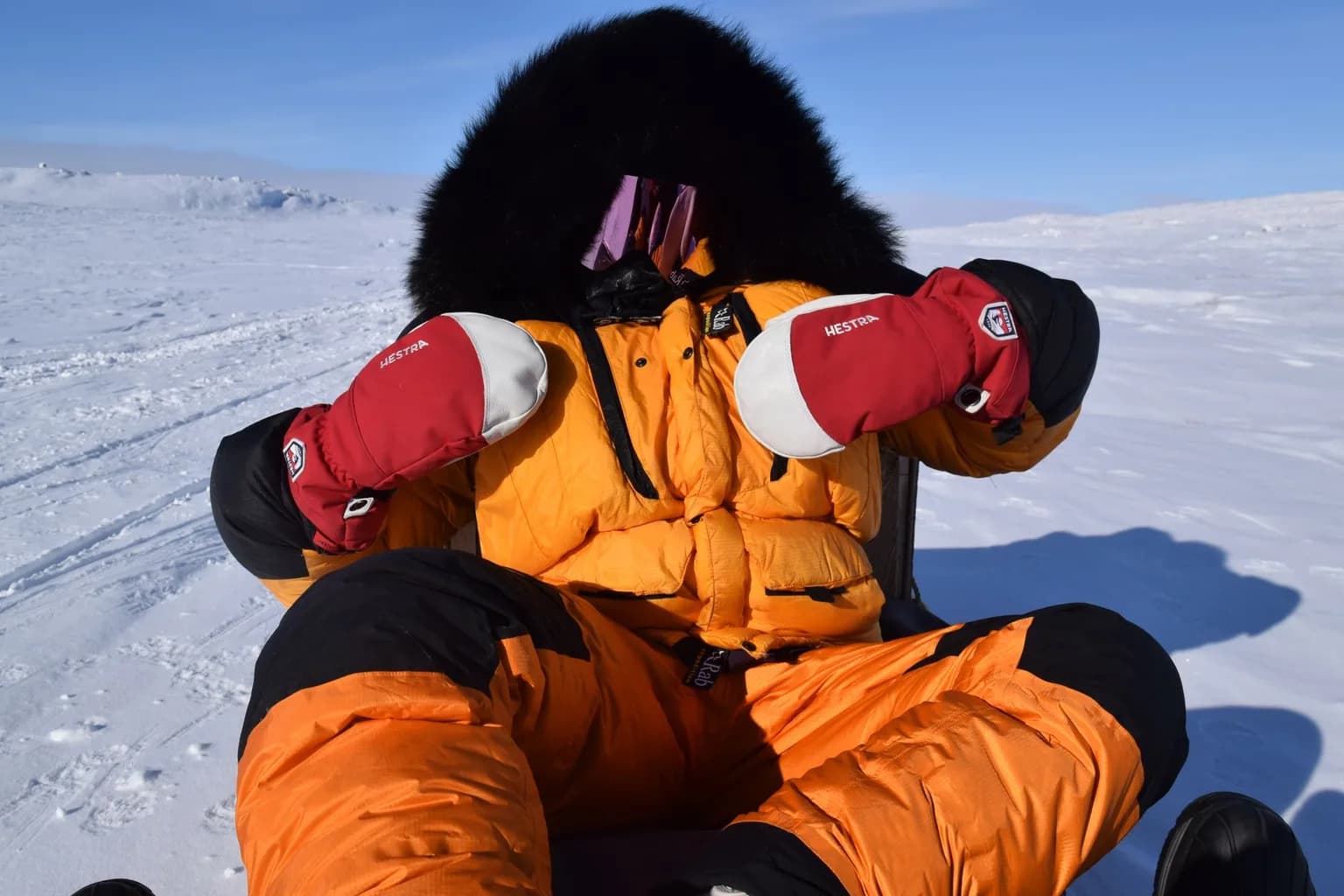
At 25, Ramón Larramendi travelled across the Arctic from Greenland to Alaska with a map and compass, at times passing two or three months without meeting anyone. “Whoever is in a hurry in the Arctic, is in a hurry to die,” he later said.
That expedition, from 12 February 1990 to 1993, gave Larramendi the knowledge that led him to devise a vehicle driven by wind across snow and ice. He began work on the Wind Sled at the beginning of this century, using Inuit sled-building knowledge acquired during that journey.
He has spent 25 years refining the design, which he says joins older sled techniques with modern equipment. “The wind sled is something completely unique in the world,” Larramendi said. “This sled combines Inuit techniques, which can look like old-fashioned and slightly strange bits of technology. That makes it a very, very unusual mix, but hugely efficient.”
The Spanish explorer and three teammates left Spain on October 18 for a 3,400-kilometer crossing of Antarctica’s interior. The group is due to travel from Russia’s Novolazarevskaya base in Queen Maud Land to the Concordia research station at Dome C, arriving in early February after 85 days on the ice.
Larramendi is travelling with Hilo Moreno, a polar guide and mountain technician; Mariusz Potocki, a University of Maine researcher; and Javier Selva, a documentary filmmaker and alpinist who crossed Antarctica with Larramendi in 2011-2012.
The route will take the team through the Pole of Inaccessibility and near the Pole of Cold at Vostok base, where the coldest temperature on Earth has been recorded. Temperatures can fall to 40 degrees below zero, with the coldest sections bringing conditions close to 50 degrees below zero.
The crew will live on a 15-meter sled made up of four modules, in an interior region with practically no data. Its 20 kites range from five to 150 square meters in sail area, and solar panels provide energy alongside the wind, without a combustion engine.
The sled can carry up to 2,100 kilograms, though this expedition is travelling lighter with around 250 kilograms of instruments. In strong wind, it can reach 80 kilometers per hour.
Larramendi has already logged more than 28,000 kilometers across ice on 13 expeditions, including 10,000 kilometers in three previous Antarctic crossings using the Wind Sled.
This journey is intended to make a different case for polar travel. The last team to complete a comparable crossing of Antarctica’s interior used roughly 170,000 liters of fuel. This crossing is set to become the first in Antarctic history with zero emissions.
There are 16 scientific projects running throughout the trip, selected by Spain’s polar research committee. Collaborators include NASA’s Ames Research Center, six Spanish universities and several national research bodies.
The work includes viral sampling, analysis of atmospheric contamination, studies of ice reflectivity, and monitoring of the crew’s psychological and physiological responses during 85 days of isolation. Five long-duration stops are planned so the team can set up scientific stations and carry out experiments.
One project, WindSled Mind, will track the team’s psychological responses, sleep and social dynamics.
On reaching Concordia, the team will fly out and leave the sled dismantled at the station for the return journey.





Comments (0)