

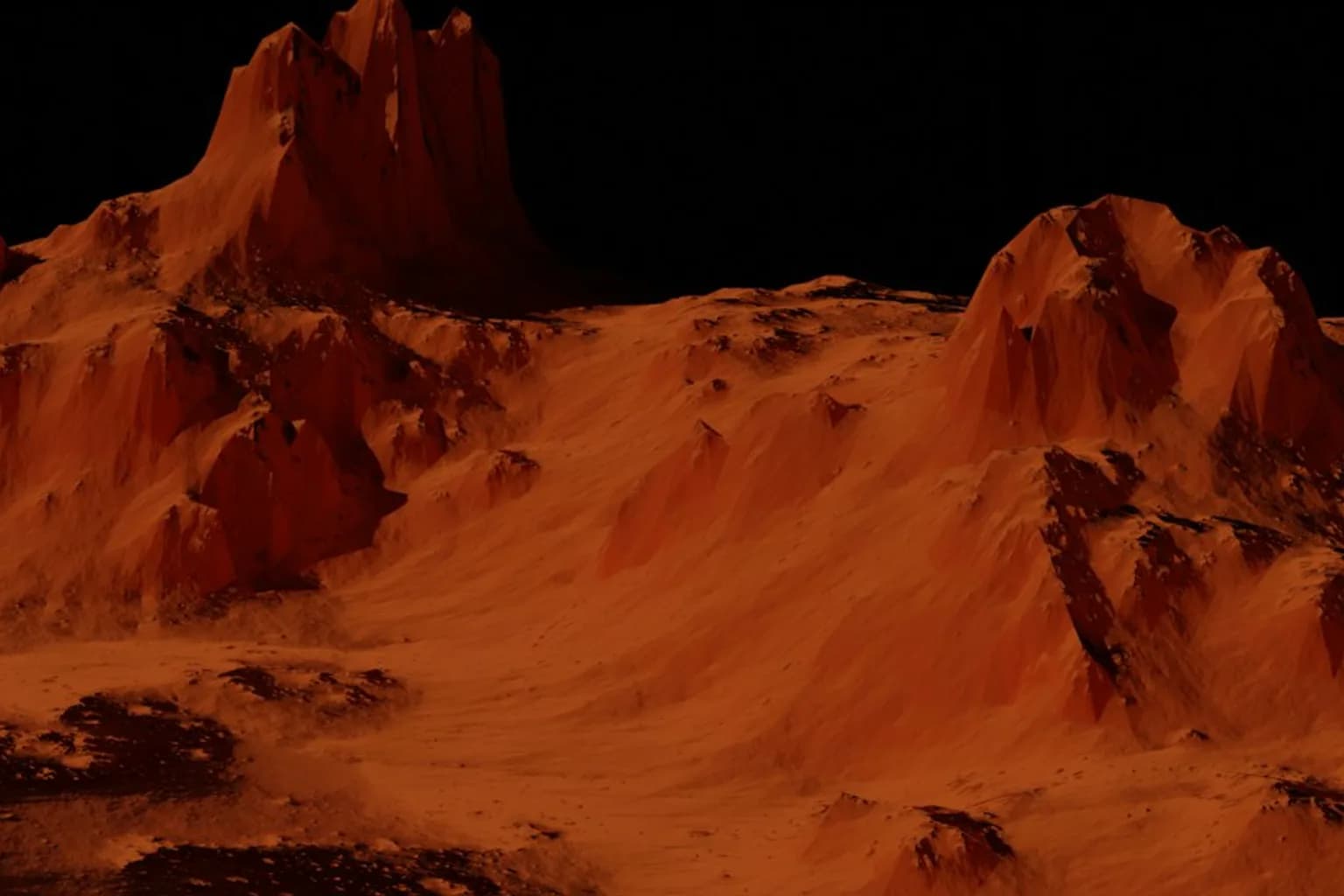
Before dawn during Mars’s southern dusty season, a thin white wisp of water ice begins forming on the western slope of Arsia Mons, about 45 kilometers above the surface. It then races westward across the southern hemisphere for about two and a half hours at roughly 170 meters per second, before fading away.
The Arsia Mons Elongated Cloud, or AMEC, reaches over 1,800 kilometers, about 1,100 miles, in length. It is nearly twice the length of the United Kingdom and about one-twelfth of Mars’s circumference.
Jorge Hernández-Bernal, a planetary scientist at LMD, CNRS and Sorbonne Université in Paris, led a team that has now modelled the cloud’s formation for the first time. Their study, published October 7 in Nature Geoscience, found that the cloud can form when water vapour freezes directly into ice crystals without dust or other particles to act as a base.
Scientists first recorded the cloud in 2018 with ESA’s Mars Express orbiter. It appears near Arsia Mons, a roughly 20-kilometer-tall extinct volcano in Mars’s Tharsis region, every morning during southern-hemisphere spring and summer.
Its regular return had posed a problem for atmospheric models. In the pre-review version of the team’s simulations, the cloud was 30% to 50% narrower than observed, began about an hour and a half late, and reached only around a quarter of the observed length before detaching. Previous AMEC models did not match images captured by Mars Express.
Hernández-Bernal’s team used a high-resolution weather model combining the Weather Research and Forecasting solver with the physics of the Mars Planetary Climate Model. When they added homogeneous nucleation, their simulation produced the cloud as observed.
“Once we included this physics in our simulations, the AMEC emerged just as we hoped. It's akin to droplets of condensation appearing in the middle of a room, rather than on a window. It's wholly unexpected,” Hernández-Bernal said.
The process depends on unusually severe conditions. Wind currents striking Arsia Mons generate a powerful wave that lifts moist air several kilometers within minutes. The rising air cools by 30 degrees Celsius in 10 minutes, creating a cold pocket where homogeneous nucleation can begin.
The researchers calculated that hundreds of ice particles per cubic centimeter form in that pocket. Their calculations required relative humidity levels more than 100,000 times greater than those measured on Earth.
Before the modelling, scientists did not know that Mars could reach such humidity levels. Homogeneous nucleation had never previously been observed in any planetary atmosphere, including Earth’s.
The cloud forms, grows and fades each day for several months. The cycle repeats every morning for about 80 days each Martian year, around the southern summer solstice.
The findings expand the range of conditions under which scientists know water ice can form in a planetary atmosphere. They also leave open questions about why the extreme conditions arise specifically near Arsia Mons, whether they occur elsewhere on Mars, what controls the cloud’s rapid dissipation and whether a similar process operates on other worlds.




Comments (0)