

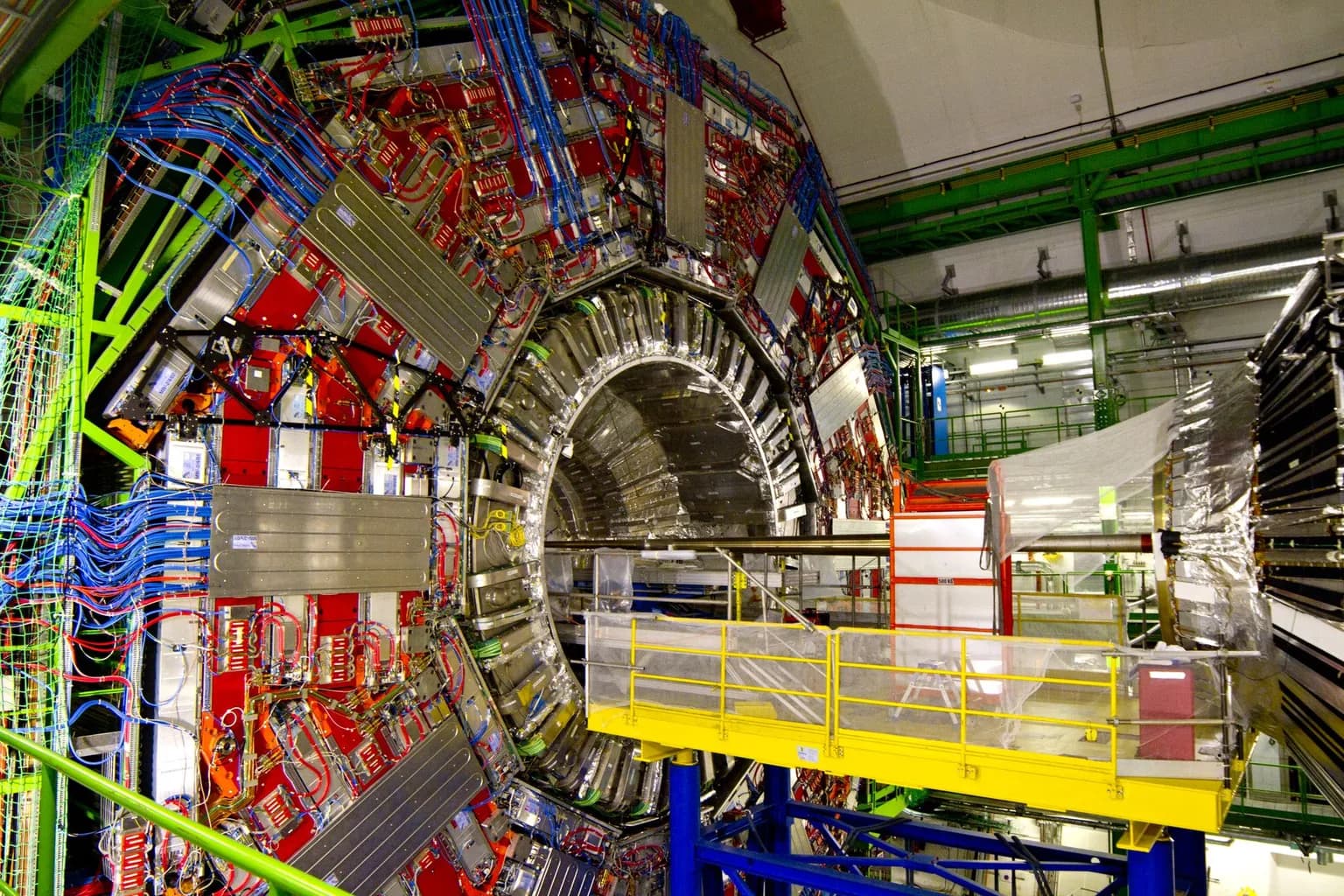
Gerald Gabrielse and his team began with a radioactive isotope of sodium-22, which releases high-energy positrons as it decays. Gabrielse, a physicist at Northwestern University in Evanston, Illinois, led the effort to capture one of those particles and keep it available for study.
The task is difficult because a positron is an electron’s antimatter counterpart, with the same mass and an opposite electric charge. Positrons usually survive for only a tiny fraction of a second, annihilating when they encounter electrons.
The researchers first passed the positrons through a special refrigerator to reduce their temperature and energy. They then sent them through a tungsten crystal, where many annihilated and the slowest surviving particles were selected.
“The biggest challenge is to persuade that high-energy positron to slow down enough that we can capture it into our particle trap,” Gabrielse said.
The physicists guided the slowed particles along a channel with electromagnetic fields and captured a single positron in an otherwise empty chamber. Electronic components created an electric field above and below it and a magnetic field at its sides, forming invisible barriers around the particle.
The experiment took place in a laboratory in Illinois, inside a refrigerated chamber kept in a near-perfect vacuum at just 0.3 degrees Celsius above absolute zero. The vacant trap isolated the positron from other particles.
“If you want to hold on to antimatter, you have to hold it in a container without walls,” Gabrielse said.
The team kept the particle trapped for months, a period that could allow it to remain confined indefinitely using this method. For the first time, scientists were able to make quantum measurements on a positron, using microwaves to control and observe its quantum energy states.
Microwave radiation prompted sudden changes between the positron’s states of spiral motion in the magnetic field. By examining data gathered during the months it was held, the researchers began measuring the antiparticle’s properties, particularly its magnetic moment.
The researchers plan to measure that magnetic moment precisely by finding the energy required to reverse the direction of the positron’s spin and to move it from its ground state to its first excited state. Magnetic moments describe how particles wobble around their axis in a magnetic field, and can be measured with 10,000 times greater precision in electrons and positrons than other properties.
Gabrielse’s team has already measured the magnetic moment of an electron to one part in 10 trillion. The Standard Model of particle physics predicts that the positron and electron magnetic moments should be exact opposites.
“We know the standard model has to be wrong somewhere—or at least incomplete,” Gabrielse said.
Just after the Big Bang, scientists think matter and antimatter existed in roughly equal amounts. When they meet, they annihilate in a burst of energy. A confirmed difference between the electron and positron magnetic moments would therefore point to a gap in the Standard Model. Whether the measurements will find such a difference remains unknown.
The team reported the achievement on 21 October in Physical Review Letters.





Comments (0)