

In 1999, NASA’s Hubble Space Telescope recorded approximately 100 chemical features it could not identify in the spectrum of HS 0209+0832, a white dwarf about 270 light-years from Earth.
Jamie Williams, a doctoral candidate in physics at the University of Warwick in the United Kingdom, returned to those archival observations with an updated chemical database. Williams found that many of the unexplained signals matched niobium, an element never previously found in a white dwarf.
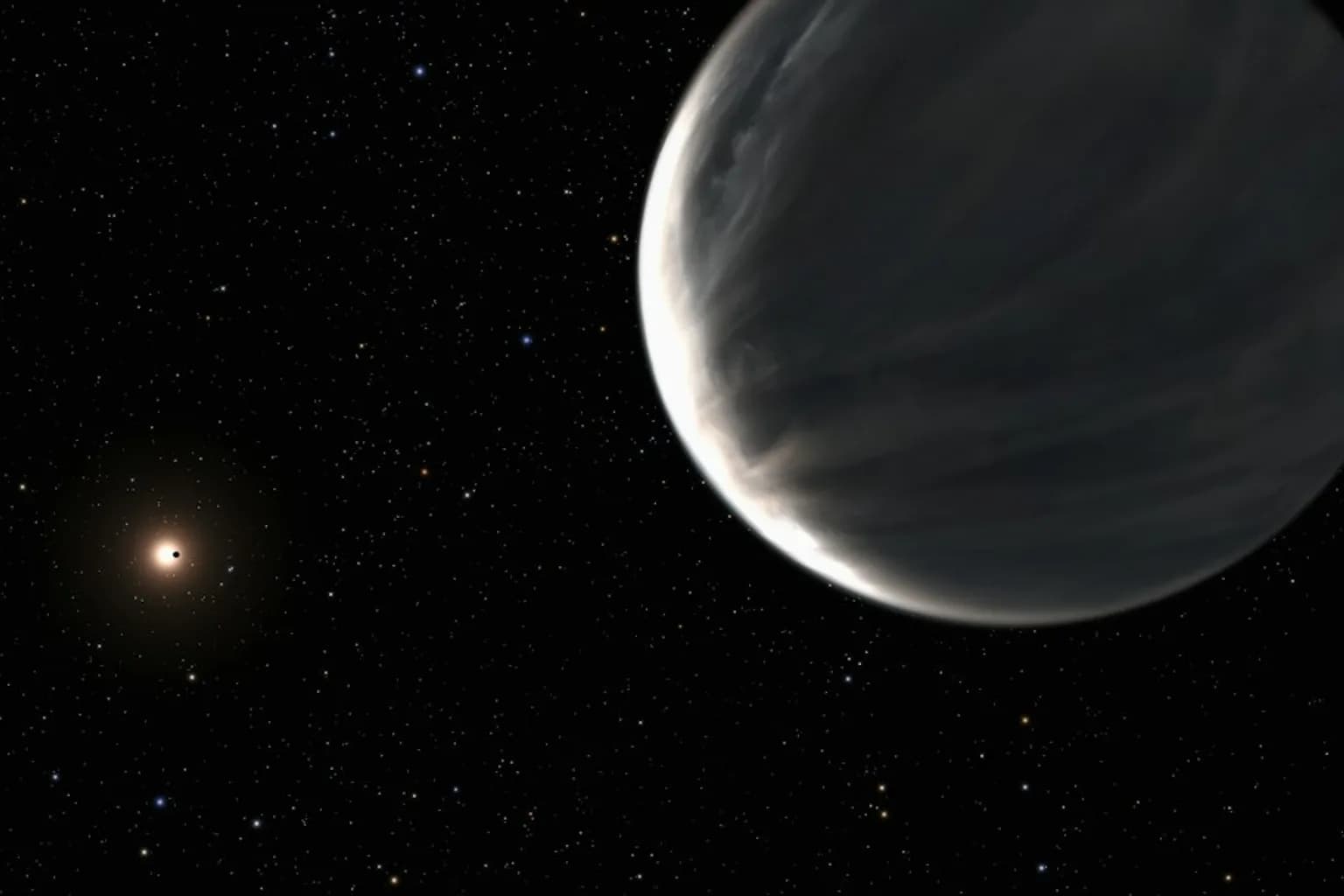
The result has led astronomers to identify the first strong hints of a newborn planet orbiting a white dwarf. The candidate appears to be a second-generation planet, made from debris shed as the star died, and is now losing its atmosphere to the same stellar remnant.
HS 0209+0832 is probably about half the mass of the Sun, compressed to the size of Earth. It is about 35,000 kelvin (~63,000°F), against the Sun’s 5,800 kelvin surface temperature (10,000°F).
A white dwarf is the remnant left by a star like the Sun after it exhausts its nuclear fuel. More than 95 percent of all stars in the universe will eventually become white dwarfs.
NASA’s retired Far Ultraviolet Spectroscopic Explorer, known as FUSE, also found large amounts of niobium in the system, corroborating the Hubble result.
Nicholas Stone, a theoretical astrophysicist at the University of Wisconsin–Madison and a member of the research team, said niobium and other elements heavier than iron are made under unusual conditions inside dying stars. Such elements cannot be formed in stellar cores through thermonuclear fusion.
The white dwarf’s atmosphere also contains copper and zinc. Researchers say the material falling on to HS 0209+0832 differs from any object in the Solar System.
NASA’s Transiting Exoplanet Survey Satellite, or TESS, watched the system for four straight months and detected changes in the white dwarf’s brightness every 4.4 days. The signal suggests a giant planet in a 4.4-day orbit.
The candidate circles only 3.7 million miles (6 million kilometers) from the white dwarf. Mercury orbits the Sun at 36 million miles (58 million kilometers).
Researchers estimate that the object is about the size of Jupiter, making it a gas giant and a type of planet known as a ‘hot Jupiter’. Its exact size and mass remain uncertain because it has yet to be confirmed as a planet.
At that close distance, the white dwarf’s heat and ultraviolet radiation are stripping the candidate’s atmosphere. The escaping material falls on to the white dwarf’s surface, enriching it with copper, zinc and niobium.
The composition of that accreted material is consistent with a planet formed from matter expelled during the star’s giant phase, before it became a white dwarf. The researchers cannot yet determine whether the planet formed solely from stellar material or whether a collision with another body played a part.
Boris Gaensicke, an astronomer at the University of Warwick and a co-author of the study, and David J. Wilson, a research associate at the Laboratory for Atmospheric and Space Physics at the University of Colorado Boulder, were among the researchers involved. Juliette Becker, a planetary astronomer at the University of Wisconsin–Madison who was not involved in the work, commented on the findings.
The study, published in Nature Astronomy on October 5, 2026, describes the object as the first candidate planet with signs that it formed from material connected to a star’s death rather than its birth, then began to be consumed by that star’s remnant.






Comments (0)