

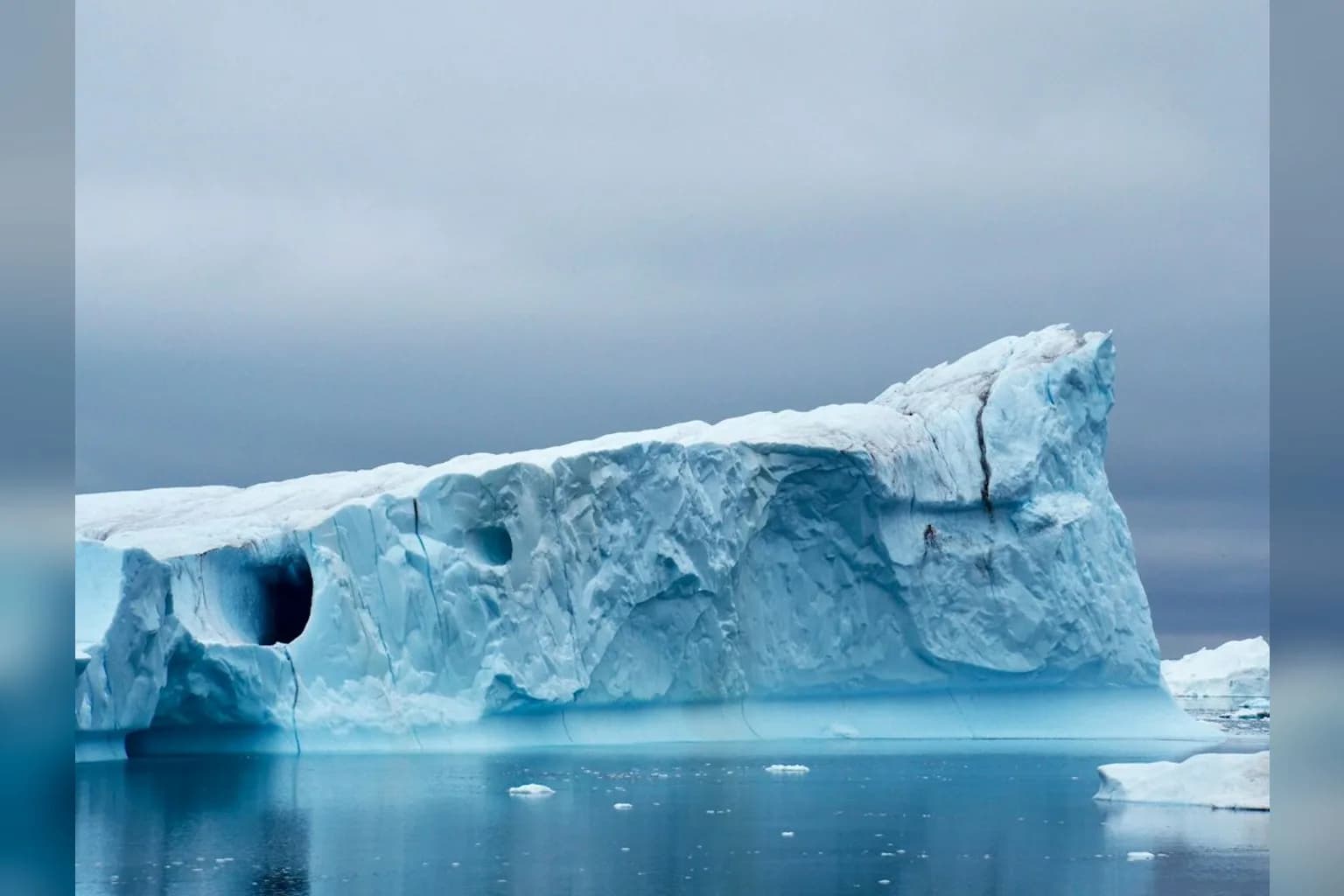
Christoforos Kotsakis, a geodesy professor at the Aristotle University of Thessaloniki in Greece, studied satellite-navigation measurements of the Earth’s surface over nearly two decades. The data point to a small but measurable shift: as polar ice melts, the poles are rising and the equatorial bulge is shrinking.
For millennia, enormous ice masses in Greenland and Antarctica pressed the crust down into the mantle. As that weight has diminished, the crust beneath the polar regions has begun a slow rebound, while meltwater has moved into oceans nearer the equator and the equatorial belt has subsided.
“Our results indicate an acceleration of polar uplift, which is accompanied by a comparatively increasing rate of equatorial subsidence. This means that the overall shape of solid Earth is becoming somewhat less flattened,” Kotsakis stated.
Earth has never been a perfect sphere. Its solid form is slightly flattened at the poles and thicker around the equator, where its diameter is about 7,926 miles (12,756 kilometers).
Kotsakis’s study used direct measurements from the global navigation satellite system (GNSS), drawn from a worldwide network of stations able to detect movement in the millimetre range. Coverage is concentrated in accessible areas, with fewer stations at the poles and in remote oceans.
Between 1997 and 2000, the solid Earth was becoming rounder by about 0.5 millimeters per year. Between 2011 and 2015, the poles rose and the equator’s bulge shrank by about 1 millimeter per year.
The pace is itself increasing. The rate at which the planet’s solid surface is rounding is accelerating by about 0.4 millimeters per year with each decade that passes.
The measurements exceed what natural processes since the last Ice Age can explain on their own. Current ice loss adds to the longer-term rebound of the crust.
Greenland and Antarctica have lost 11 trillion tons of ice since the 1970s, raising global sea levels by more than three centimeters.
The change depends on which part of the planet is measured. The solid Earth is becoming rounder, while the combined shape of the solid Earth and the ocean is getting flatter by about 0.8 millimeters per year, because ocean water is becoming more concentrated at the equator.
Earth’s gravitational field is changing in the opposite direction to the solid surface, becoming flatter as meltwater enters oceans near the equator.
The redistribution of mass is also slowing Earth’s rotation, in the same way an ice skater slows when extending her arms during a pirouette.
Donald Argus, a NASA Jet Propulsion Laboratory researcher who studies shifts in the planet’s mass distribution, and colleagues found that the annual fluctuation of Earth’s center of mass is now estimated to be only about half as large as was assumed eight years prior.
Scientists are examining what these changes mean for highly precise GPS navigation and international timekeeping. Future adjustments of leap seconds may be necessary.




Comments (0)