

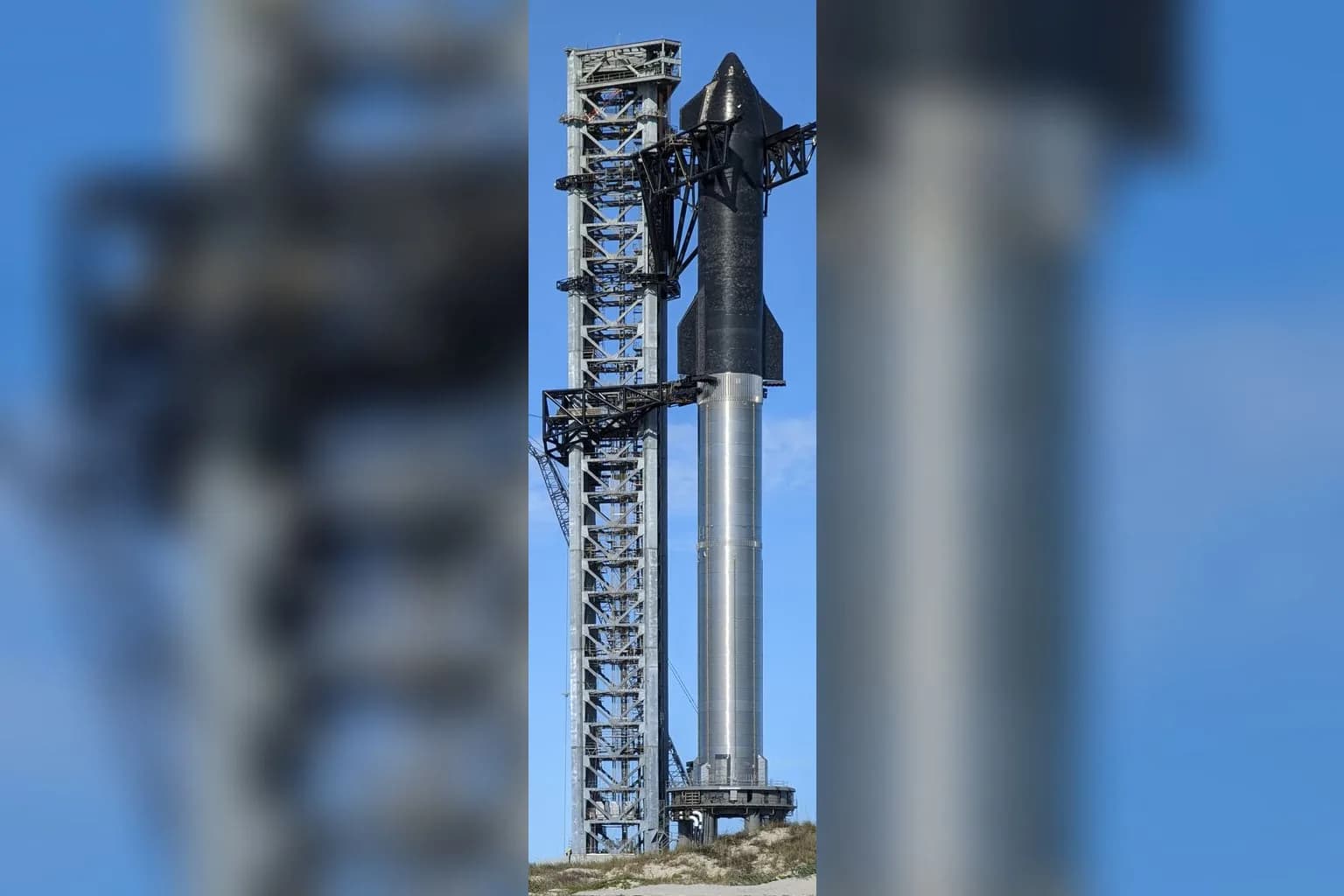
SpaceX aborted an attempt to catch Starship’s lower booster on Friday after an automatic abort sent it into the Gulf of Mexico.
The 124-metre-tall rocket lifted off from SpaceX’s Starbase launchpad in Boca Chica, Texas, at 1645 local time. Starship consists of the lower Super Heavy booster and the upper stage, known as the Ship.
The booster had been due to return six and a half minutes after take-off, when mechanical arms on the launch tower, known as chopsticks, were meant to catch it. Instead, the booster malfunctioned, was diverted to the ocean and burst into flames. The cause of the malfunction is unknown.
The Ship continued its flight and is deploying 26 satellites. It is due to make 14 orbits around Earth before returning to the launch tower 22.5 hours after lift-off. SpaceX may try to catch the upper stage at about 1515 local time on Saturday.
The attempt would be the first in which a spacecraft returns to the pad from orbit to be caught in mid-air by the tower’s mechanical arms. SpaceX has caught Super Heavy boosters on three earlier test flights, though it has never caught the upper stage with the chopsticks.
A SpaceX spokesperson said: ‘Safety is always the number one priority, and we're still testing out things that we haven't done before on these vehicles, and so we are prioritising making sure that we can perform each maneuver safely.’
Test Flight 15 is SpaceX’s most ambitious Starship mission so far. Had both stages been recovered, it would have been the first time every part of a rocket launched into orbit had been recovered for reuse. SpaceX became the first company to vertically land part of a rocket when its Falcon 9 booster did so in 2015.
SpaceX founder Elon Musk has said full reusability is needed for the rapid and frequent launches he sees as necessary to build bases on the Moon and send humans to Mars. SpaceX also has a NASA contract to adapt the Ship into a lunar lander, as NASA plans to land humans on the Moon in 2028.





Comments (0)